Karachi's Polluted Air and Your Lungs: Simple Protection Tips for Asthma, Allergy, and Heart Patients
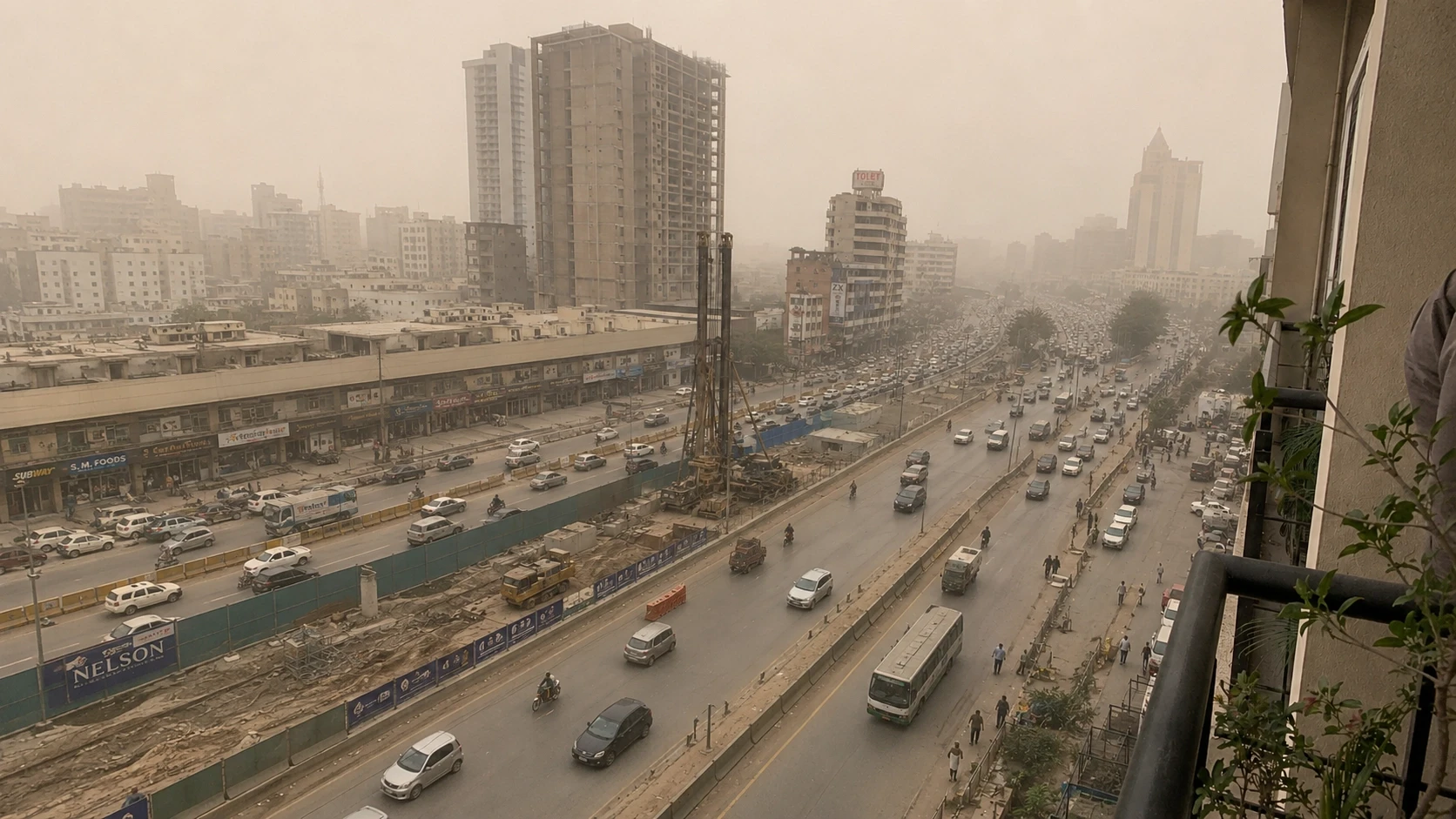
You only need to step outside during that hectic morning rush on Shahrah-e-Faisal to know what is going on. A brown haze sits low over the road. Black exhaust is pumped into the gap between vehicles by buses. There's a trench cut open somewhere nearby for the gas pipeline, and the bare earth combined with construction dust and traffic fumes is almost palpable. That air is not neutral for people who suffer from asthma, allergies or a heart condition. It is working against you, quietly, every single day.
Karachi is among the most polluted megacities in the world. Climate TRACE analysis identified Karachi as the urban area with the largest number of people exposed to unhealthy air pollution levels in 2026. Karachi's annual average AQI for 2026 stands at 115 - classified as unhealthy for sensitive groups - and during winter smog peaks, readings across the city's districts have soared past 180, with North Nazimabad recording a terrifying AQI of 226. Pakistan's average PM2.5 concentration in 2025 was 67.3 µg/m³ - nearly 14 times the WHO annual guideline, making it the most polluted country in the world by this measure. In 2026, only 1% of days met WHO safe air quality limits.
As you would expect, those bearing the worst of it are patients with asthma, high blood pressure, heart disease, chronic allergies and COPD, as well as the children and elderly who live with them. The honest truth is that you cannot fix Karachi's air on your own. The trucks on University Road, the open burning behind your building, and the road digging that puts a cloud of fine dust at window height every time you walk past - you cannot stop any of these. But you can build a daily protection plan around what the air actually is - not what you wish it were. That is what this guide is for.
Quick Reference: Karachi Air Situations and What to Do
Situation in Karachi | What It Means for Your Lungs & Heart | One Practical Action You Can Take |
AQI shows Unhealthy or worse near major roads | High fine particles trigger asthma attacks, allergy flares, and strain the heart and blood vessels. | Wear a quality mask outdoors, keep windows closed during peak traffic hours, and use teleconsult instead of non-urgent trips. |
Ongoing road digging for gas/water lines on your street | Local dust and fine particles rise sharply near the digging site - especially for those living or walking past it daily. | Change your walking route if possible, use a mask near the site, keep doors/windows closed, and wet-mop indoor dust more often. |
Riding a bike/rickshaw/Chingchi along University Road or Shahrah-e-Faisal at rush hour | Direct exposure to exhaust fumes and fine particles at close range - hits asthma, COPD, and heart patients hardest. | For high-risk patients, prefer closed vehicles, avoid peak hours, and choose teleconsult when symptoms are unstable. |
Burning trash, qurbani leftovers, or random smoke near your home at night | High irritant exposure - especially dangerous for children, the elderly, asthma patients, and heart patients. | Close windows, move to a room farther from the smoke, use a mask if you must go out, and speak to local authorities if burning is frequent. |
How Karachi's Air Hurts Your Body
Asthma and Allergies in Dust and Smog
When your asthma has been harder to control lately - more rescue inhaler use, more night-time coughing, or reduced breathing after just a short walk - the air is a strong suspect. Karachi's combination of vehicle exhaust, construction dust, road-level fumes and trash-burning smoke delivers a high load of PM2.5 and PM10 particulates directly into your airways. PM2.5 particles are smaller than 2.5 micrometres - far smaller than a human hair - and are able to travel through the nose and throat to reach the bronchioles. There, they induce bronchospasm - the sudden vice-like tightening in the chest - and stimulate excess mucus production, narrowing the airway further.
Allergy patients get hit differently but equally hard. Karachi's coastal dust mixes with pollution particles that attach to pollen and mould spores, making them more biologically reactive. Your immune system interprets them as threats and overreacts: runny nose, burning eyes, sneezing, and airway inflammation that compounds the asthma picture if you have both conditions. The risk is measurably elevated on bad AQI days - when that haze you can see from your building's window is especially thick. A published study on Karachi specifically found that short-term spikes in PM2.5 were directly associated with a significant rise in hospital admissions and ER visits for respiratory disease. The impact was felt within four days of a high-pollution episode. That is the lag time between the smoke you breathe today and the flare that brings you to hospital later in the week.
What this means in practice: you need your inhaler more often than your plan calls for, you wake up coughing at 2 a.m., and a walk to the pharmacy feels harder than it should. These are not minor symptoms - they are signals that your airways are in active exacerbation. On days when the AQI is reporting Unhealthy or Very Unhealthy, reducing your outdoor time is not overcaution. It is clinical sense.
When Bad Air Hurts the Heart
For heart patients, air pollution is not just a lung problem. PM2.5 particles fine enough to reach the lungs also cross into the bloodstream. Once in circulation, they drive systemic inflammation, endothelial dysfunction - damage to the lining of blood vessels - and oxidative stress that accelerates the hardening and narrowing of arteries. The result is raised blood pressure, greater cardiac workload, and heightened risk of ischaemia - reduced blood supply to the heart muscle.
In practical terms: if you are walking down a dusty street near an open construction site and feel unusually breathless, a heaviness in the chest, or palpitations you do not normally get, the pollution load is a real contributing factor - not just anxiety. A major 2025 review published in a peer-reviewed medical journal concluded that PM2.5 drives hypertension, atherosclerosis, myocardial infarction, stroke, and arrhythmias through these biological mechanisms. More directly, a large-scale 2026 cohort study found that every 1 µg/m³ increase in PM2.5 exposure was associated with a 0.5% higher cardiovascular disease risk. During bad periods, Karachi's PM2.5 concentration is not a few micrograms above the guideline - it runs tens of times above it.
A July 2025 cardiac MRI study found that even modest increases in long-term PM2.5 exposure produce measurable structural changes in heart tissue - adding to cardiovascular risk that conventional tests like blood pressure and cholesterol checks cannot fully capture. If you are already managing hypertension or coronary artery disease and notice that high-pollution days consistently bring fatigue, breathlessness on mild exertion, or chest discomfort, tell your doctor. This is a pattern, not coincidence. It is worth discussing at your next consult - including whether a home doctor consultation in Karachi on bad-air days keeps you safer than travelling across the city to reach a clinic.
University Road, Shahrah-e-Faisal, and the Dust Corridor Effect
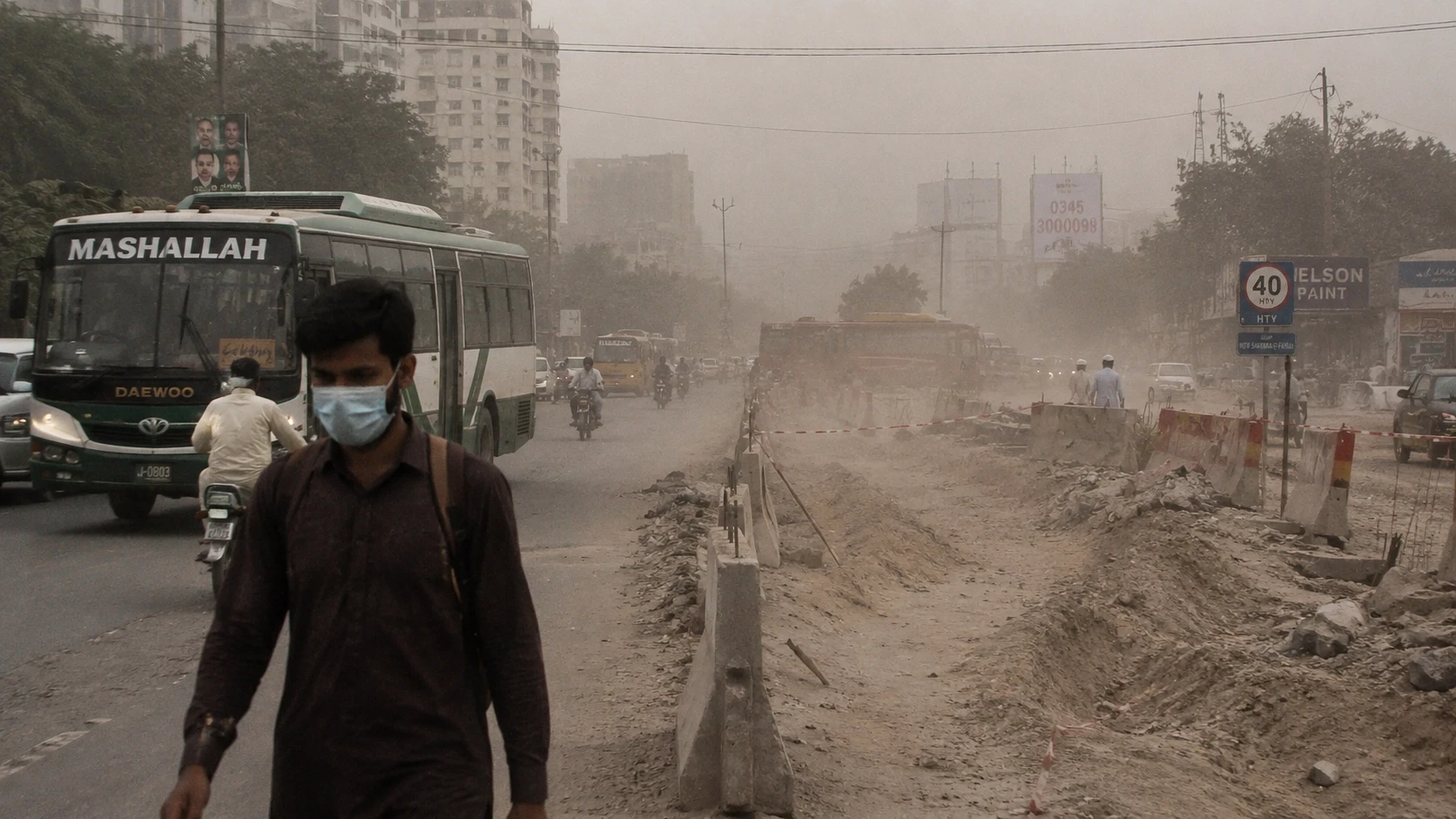
Those who live, work or commute along University Road and Shahrah-e-Faisal are not just passing through pollution. They are absorbing it in concentrated doses, repeatedly, over years. Both arteries carry heavy bus and truck traffic, and both have had extensive sections opened for pipeline work - water, gas, or telecom - leaving raw earth exposed, often without effective dust suppression, for weeks or months at a time. When a large vehicle passes an open trench at speed, you can taste the dust cloud it kicks up. That is not a metaphor. That is PM10 and PM2.5 entering your mouth and throat.
The 'dust corridor' effect is cumulative. Studies from Karachi show that PM2.5 levels are significantly higher near industrial zones and heavy-traffic arteries, and that the exposure at road level - where a pedestrian, motorcycle rider, or Chingchi passenger actually breathes - is substantially worse than what a distant monitoring station records. For an asthma or COPD patient commuting this route daily, the weekly pollution dose is multiplied relative to someone who takes back streets or travels in an enclosed, air-conditioned vehicle. Choosing a different route is not always possible. But on high-exposure days - when the construction crew is actively digging, when wind is low and dust hangs in the air - travelling this corridor on foot or in an open vehicle for a non-urgent appointment is a genuine risk, not a trivial inconvenience.
This is precisely the situation where at-home asthma and allergy care in Karachi makes practical clinical sense. If your condition is unstable and the road to your doctor runs directly through a dust corridor that will trigger a flare, staying home and consulting remotely or booking a home visit is not laziness. It is the medically rational choice.
Indoor Air in Karachi Flats: Not as Safe as You Think
Closing your windows feels like protection. In Karachi, it is partial protection - and it is worth understanding what that means. Fine particles at PM2.5 size can infiltrate buildings through gaps around doors, windows, and AC units. If you live on a lower floor of a building on a busy road, your indoor PM2.5 levels on bad days can approach outdoor levels within a few hours of the traffic peak. Add indoor pollution sources - cooking on a gas stove, mosquito coils burning overnight, incense sticks, and neighbours' tobacco smoke drifting through shared corridors - and you can have an indoor air problem even when the windows are shut.
Mosquito coils and agarbatti (incense) are particularly worth flagging for asthma patients. Both emit fine particles and volatile organic compounds that directly irritate inflamed airways. A coil burning in a closed bedroom overnight is a sustained low-level exposure that can tip a controlled asthma patient toward a night-time exacerbation. The cough you wake up with at 3 a.m. may not be outdoor smog - it may be what you lit before you fell asleep. Switching to plug-in repellents or mosquito nets removes this trigger entirely.
Practical indoor strategies that genuinely reduce exposure: wet-mopping floors every day or two (dry sweeping lifts particles into the air; wet-mopping captures them), using a damp cloth on window sills and surfaces near windows, ventilating the home when outdoor AQI is acceptable - post-rain air is typically the cleanest you will get in Karachi - and eliminating mosquito coils and incense for asthmatic household members. These are not glamorous interventions. But they reduce your total pollution dose over the course of a day, and for lungs already under strain, every reduction matters. For ongoing guidance on managing high blood pressure related to cardiac risk, SehatDoor's clinical blog covers home monitoring approaches that pair well with these environmental controls.
When You Need a Doctor, Not Just a Mask
Wearing masks, adapting indoor air habits, and changing routes reduce your exposure. They do not eliminate it, and they do not treat an active flare. There are specific symptom clusters that require medical assessment - not a second inhaler puff and a wait-and-see approach.
Red-Flag Symptoms: Go to the ER - Do Not Teleconsult
Tight chest + fast breathing + cannot speak full sentences.
Reliever inhaler not bringing relief within 15–20 minutes, or needed more than every four hours - this is severe exacerbation territory.
Confusion, blue or pale lips, or visible use of neck and rib muscles to breathe - emergency signs. Go to the ER immediately.
Heart patients: new or worsening chest pain or pressure, breathlessness significantly worse than your usual baseline, palpitations that do not settle, sudden dizziness or confusion.
Any one of the cardiac flags on a high-pollution day warrants emergency evaluation - treat as urgent until proven otherwise.
Between these emergencies and a completely stable day, there is a wide middle ground - unstable symptom control that needs a doctor's eyes but does not yet need an emergency room. That is the space where SehatDoor teleconsult for asthma and heart patients is designed to work. If your symptoms have worsened over two or three days, your inhaler use is climbing, or your BP readings at home are running higher than usual on consistently bad-air days, a teleconsult with a qualified doctor can assess whether your maintenance regimen needs adjusting - without putting you in a rickshaw on Shahrah-e-Faisal for a non-emergency visit.
Your Daily Protection Plan in Karachi Air
This is not a perfectionist checklist. It is a realistic set of habits that create multiple small layers of protection - each one modestly useful, together meaningfully protective.
Check AQI every morning. Use an AQI app or aqicn.org/city/karachi. Treat an Unhealthy reading the way you would treat a heavy rain warning - adjust your plans, don't ignore the number.
Keep your medications in one place. Reliever inhaler, prescribed controller medication, and heart medicines in one accessible pouch, ready before you leave the house. On high-exposure routes and bad-air days, the question is not whether you will need them but whether you can find them quickly if you do.
Use a proper mask. A good-quality N95 or KN95 - not a single-layer fabric mask - on Very Unhealthy AQI days, near construction sites, and along heavy-traffic corridors. Fit matters: the mask must seal against your face. A mask worn loosely around the chin is decoration.
Change your route and timing when you can. Back streets instead of University Road. Early morning or evening instead of the 8–10 a.m. rush. It does not need to be every trip - just on the days when the air is worst and your symptoms are least stable.
Indoor air habits. Wet-mop floors regularly, replace mosquito coils with alternatives for asthma patients, do not sweep dry dust indoors, and ventilate aggressively after rain when outdoor air quality is briefly better than usual.
Consider teleconsult for routine follow-ups on bad-air days. If you have high-risk conditions - asthma, COPD, heart disease, or uncontrolled hypertension - and a follow-up falls on a day when the air is particularly bad, consider whether that trip is essential today. A SehatDoor teleconsult for asthma and heart patients or at-home visit keeps you out of peak-hour pollution without skipping medical care.
For parents: Children's airways are proportionally smaller and their breathing rates higher than adults, which means they absorb more pollution per kilogram of body weight. On bad AQI days, keep school-age children with asthma or recurrent chest infections indoors if possible, and keep their inhaler at school as well as at home.
Rapid-Fire Clinical FAQs
Q: How do I know if today's Karachi air is too dangerous for my asthma or heart problem?
Check the real-time AQI at aqicn.org/city/karachi or aqi.in - if it is above 100 (Unhealthy for Sensitive Groups) and you have asthma, COPD, or heart disease, reduce outdoor exposure. Above 150 (Unhealthy), limit all non-essential outdoor activity. If you are already symptomatic, consult a doctor before going out regardless of the AQI reading that day.
Q: Does wearing a mask really help against Karachi's pollution, or is it useless?
A properly fitted N95 or KN95 mask reduces your PM2.5 inhalation meaningfully - it is a risk-reduction tool, not a complete barrier. A loose surgical or fabric mask provides much less protection against fine particles. Fit matters: the mask must seal against your face. Patients with very severe COPD or heart failure should check with their doctor before using tight-fitting masks, as the added breathing resistance can be taxing.
Q: Can air pollution alone trigger a heart attack or stroke if I already have heart disease?
Yes. Short-term peaks in PM2.5 can trigger coronary events in patients with pre-existing cardiovascular disease through inflammation, blood pressure spikes, and clotting changes. This is not theoretical - it is supported by large-scale research published in 2025 and 2026. On very high pollution days, minimise physical exertion outdoors, take your medications as prescribed, and seek immediate emergency care for any new or worsening chest pain, breathlessness, or neurological symptoms.
Q: What simple changes at home actually reduce dust and smoke exposure for my kids?
The most effective low-cost changes are wet-mopping floors instead of dry sweeping, eliminating mosquito coil use in rooms where children sleep, keeping windows closed during peak traffic hours (typically 7–10 a.m. and 5–8 p.m.), and airing the home out fully after rain. If your child has recurrent chest infections, an at-home doctor visit to review their management plan is worth considering - especially if school-day pollution exposure is heavy.
Q: Is it better to go to the hospital for every asthma flare, or can I use teleconsults and home visits?
Not every flare needs a hospital. Mild worsening - slightly more cough, one extra inhaler puff - can often be managed at home under guidance from a doctor by teleconsult or home visit. Severe flares - reliever not working, tight chest, unable to speak full sentences, oxygen saturation dropping - require the ER. The key is not guessing alone: a teleconsult can help you decide which category you are in and whether you need to go out.
Q: When should I call an ambulance instead of waiting for a home doctor if I cannot breathe properly?
Call immediately for any of the following: breathing so difficult you cannot speak, blue or grey lips or fingertips, confusion or loss of consciousness, chest pain that is new or severe, or a known asthma patient not responding to back-to-back reliever inhaler doses. These are emergency signs. Do not wait for an at-home visit - call 1122 (Rescue Pakistan) or get to the nearest emergency department.
Q: Which symptoms mean my allergy or asthma is out of control and I need to change treatment?
Signs that your current regimen is failing: you are using your reliever inhaler more than three times a week for symptoms (not before exercise), you wake at night coughing or wheezing more than once a week, or you have had one or more courses of oral steroids in the past year. These are not minor inconveniences - they indicate poorly controlled disease that needs a medication review, not just more of the same. Book a consult, whether in-person on a clean-air day or via teleconsult through SehatDoor.
One Last Thing Worth Saying Plainly
Karachi's air problem is real, it is worsening, and it is not your fault. You did not build the road infrastructure, you are not burning the trash, and you cannot relocate on two days' notice. What you can control is your personal exposure on the worst days, the state of your indoor air, the accessibility of your medications, and the decision about when going out through polluted roads is worth the health cost versus when a home doctor consultation in Karachi or a teleconsult keeps you safer at home.
No single layer of protection is perfect. The mask is not perfect. The closed window is not perfect. The route change is not perfect. But each layer reduces the dose. For lungs that are already inflamed from asthma, for airways narrowed by COPD, for a heart already managing hypertension or post-event recovery, even a modest reduction in daily PM2.5 intake is a genuine clinical gain.
Karachi will not be fixed overnight. Build your protection plan around that reality - not around the air you wish you had.
Medical Disclaimer: This article is intended as general public health education only. It does not constitute diagnosis, prescribed treatment, or a replacement for professional medical advice. Anyone with asthma, heart disease, COPD, or another chronic condition should consult a qualified physician for management of their specific condition. If you are experiencing a medical emergency, seek emergency care immediately.

Dr. Munazza
A General Physician (MBBS) with 5+ years of experience, currently working as an RMO at Saifee Hospital, focused on diagnosing, treating, and managing common health conditions.