C-Section Recovery: When Is It Safe to Start Walking, Stretching, and Core Work?
You're in a hospital bed, numb in your abdomen and with a catheter still in place, and someone - a family member, a nurse, a kind neighbour - tells you to get up and walk. Or the other way around: someone else says don’t move, don’t dare move, your stitches will open. Both feel certain. Neither of them operated on you.
This is the reality for thousands of women in Karachi every week. A cesarean section is no minor procedure. It cuts through skin, subcutaneous fat, the fascia of the anterior abdominal wall, and the uterus itself - seven distinct layers in most cases. The outside scar heals in weeks. The fascial layers and the uterine wall take months. And the pelvic floor, which has been compressed and offloaded throughout pregnancy and then abruptly left without its normal loading patterns post-surgery, doesn’t announce its dysfunction loudly. It makes its presence known months or years later, in the form of lower back pain, urinary leakage, or a dragging heaviness nobody warned you about.
A 2025 study published in BMC Pregnancy and Childbirth reveals that Pakistan’s C-section rate climbed from 3.1% in 1992 to 22.3% by 2017-18 and continues rising, driven heavily by private-sector overmedicalisation of childbirth in urban centres. A 2024 analysis in Cureus found that 44% of all deliveries at a tertiary-care hospital were cesarean. Globally, over 21% of births now occur by C-section and that number is projected to reach 28.5% by 2030. Many private maternity wards in Karachi have a far higher rate. This means an enormous number of women are going home with a healing abdominal wound, no physiotherapy referral, conflicting advice from family, and no clear framework for when and how to start moving again.
I am a Karachi-based Doctor of Physical Therapy. I visit homes - small apartments in Gulshan, walk-up buildings in Nazimabad, family houses in DHA where the patient’s mother-in-law has already decided what recovery looks like. I see women at day three who are terrified to sit up straight. I see women at week five trying to scrub floors because they feel like a burden. Both extremes cause harm. This article gives you a clear, clinically grounded answer to the most common question I hear: when can I safely start moving after a C-section, and what does “safe movement” actually mean?
Quick Reference: Post-C-Section Movement Guide
The Post-C-Section Situation | What’s Safe (If Cleared) | When You Must Stop and Call a Doctor |
First time getting out of bed in hospital | With nursing and medical clearance, gentle assisted sitting and standing can begin within 24 hours under Enhanced Recovery After Cesarean protocols, if vitals and bleeding are stable. A nurse or physiotherapist should guide the first transfer. | New sharp pain, dizziness, heavy vaginal bleeding, or any sensation that the wound is pulling or tearing. |
Slow walking in the apartment, weeks 1-2 | Short, frequent walks on flat surfaces while supporting the abdomen can help circulation and reduce clot risk. Pain should stay mild and must not spike after activity. | Sudden increase in vaginal bleeding, wound redness or warmth, fever above 38°C, or shortness of breath. |
Gentle stretching and deep breathing, weeks 3-4 | Upper-body and calf stretches, ankle circles, and diaphragmatic breathing - if your OB has cleared you. Nothing that arches the lower back or places direct traction on the incision line. | Intense pulling at the scar, bulging along the incision, or new pelvic heaviness and pressure that worsens with movement. |
Thinking about core exercises, after 6-8 weeks | Breath-based deep core activation - not crunches - guided by a qualified DPT can begin once medically cleared, to gradually restore support to the scar and pelvis. | Visible doming or coning along the midline, urinary leakage, pain at the incision, or pelvic pain that worsens with core work. |
The Science of C-Section Healing and Movement
What Actually Happens in a C-Section
Most patients are told they had a "small operation" and sent home with a wound care sheet. What they are not told is that their surgeon cut through up to seven tissue layers to deliver that baby. The skin and subcutaneous fat are the first two. Below that is the anterior rectus sheath - the fascia that encases the rectus abdominis muscles. The muscles are separated. Then comes the peritoneum. Then the uterus itself, in two layers. Each of these structures heals on its own timeline, with the skin healing fastest and the fascia nowhere near fully repaired when the outside looks clean.
The linea alba - the connective tissue running down the centre of the abdominal wall - is already under strain from pregnancy-related diastasis recti in most women. Surgery adds a healing demand directly adjacent to that structure. Loading it too early, with activities that spike intra-abdominal pressure such as lifting, straining, or doing sit-ups, can disrupt the fascial repair process. "I feel fine" is not a reliable clinical signal here. Local tissue oedema and residual anaesthetic effects blunt sensation for days. Numbness around the incision site can persist for months due to superficial nerve disruption.
Why Early Gentle Walking Helps - When It's Done Right
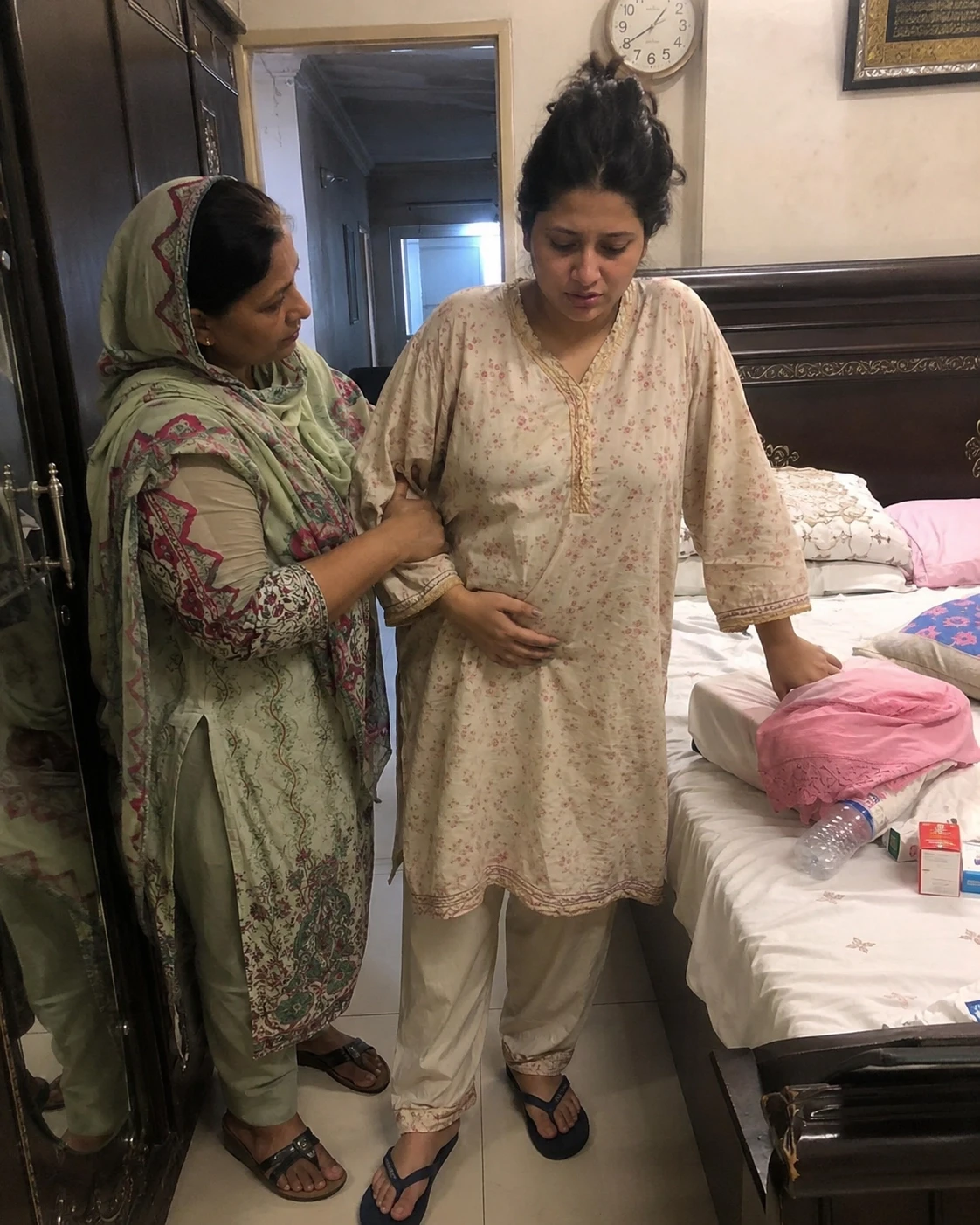
Staying completely immobile after a C-section is not safe either. Prolonged sitting and immobility dramatically increases the risk of deep vein thrombosis (DVT) and pulmonary embolism - thromboembolic events are among the leading causes of maternal death in the postoperative period. Short, frequent walks on flat surfaces help maintain venous return, reduce pulmonary stagnation, and prevent the joint stiffness and deconditioning that makes recovery harder as the weeks go on. The surgery has already begun causing gluteal and core weakness, and prolonged immobility compounds it.
"Short and frequent" really means that. In the first week at home, we are talking about walking from the bedroom to the kitchen and back. Slowly. One hand placed loosely over the lower abdomen, if this is comforting. Not power-walking to the end of the street. Not climbing three flights of stairs in a building where the lift is out during load-shedding - a scenario I encounter weekly in Karachi. When living in a walk-up building with no option to avoid stairs, use the bannister, go one step at a time, and count it as sufficient exertion for that hour.
The key sign that you have overdone it is not pain during the walk. It is whether pain or bleeding increases after you return to rest. That post-activity spike is your body's clear signal that you have exceeded your current tissue tolerance. Gentle walking is not carrying groceries up three flights of stairs - and that distinction should not need to be stated, but it does, constantly.
Stretching After a C-Section: Helpful vs. Harmful
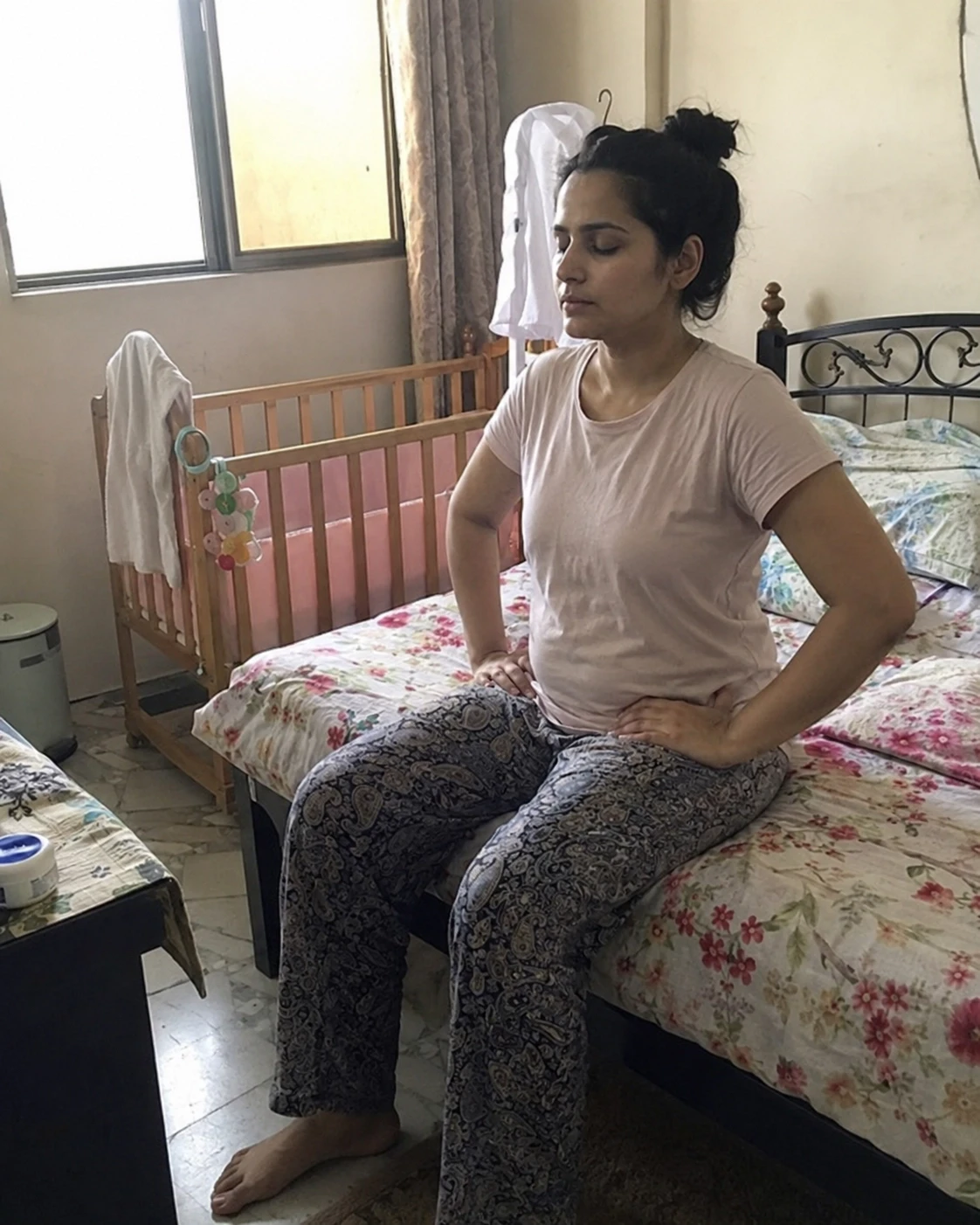
The safest stretches earliest are those furthest from the incision. Gentle ankle circles, seated calf raises, and shoulder rolls create movement, improve circulation, and reduce the muscular tension that builds from the protective, hunched-over posture most women adopt instinctively after surgery. Diaphragmatic breathing is not just a relaxation technique here. It is functional rehabilitation - each full inhale gently mobilises the diaphragm, creates gentle intra-abdominal pressure cycling, and begins the process of reconnecting the breath to the deep core.
What will stress healing tissues: deep backbends, full spinal twists, aggressive hip flexor stretches that pull the anterior abdominal wall into extension, and any movement performed with a Valsalva manoeuvre - breath held, trunk braced hard. The scar tissue under tension can be felt as a burning or dragging sensation when trying to stand fully upright. That is the feeling of loading the scar tissue. That is work you do gradually. You do not push through it. The recent systematic review on postpartum rehabilitation confirms that physiotherapy-guided, progressive interventions - not self-directed intensity - produce the best musculoskeletal outcomes postpartum.
Upper-body work - gentle neck mobility, thoracic rotation while seated, wrist and shoulder circles - is generally safe to begin within the first two weeks and actively helps with the postural strain of breastfeeding and infant care. The shoulder tension from hours of feeding with poor positioning accumulates rapidly and is entirely preventable with early guidance.
Core Work: Timing, Technique, and Red Flags
"Core exercises" does not mean crunches. It does not mean leg raises. It does not mean the 30-day ab challenge someone forwarded on WhatsApp.
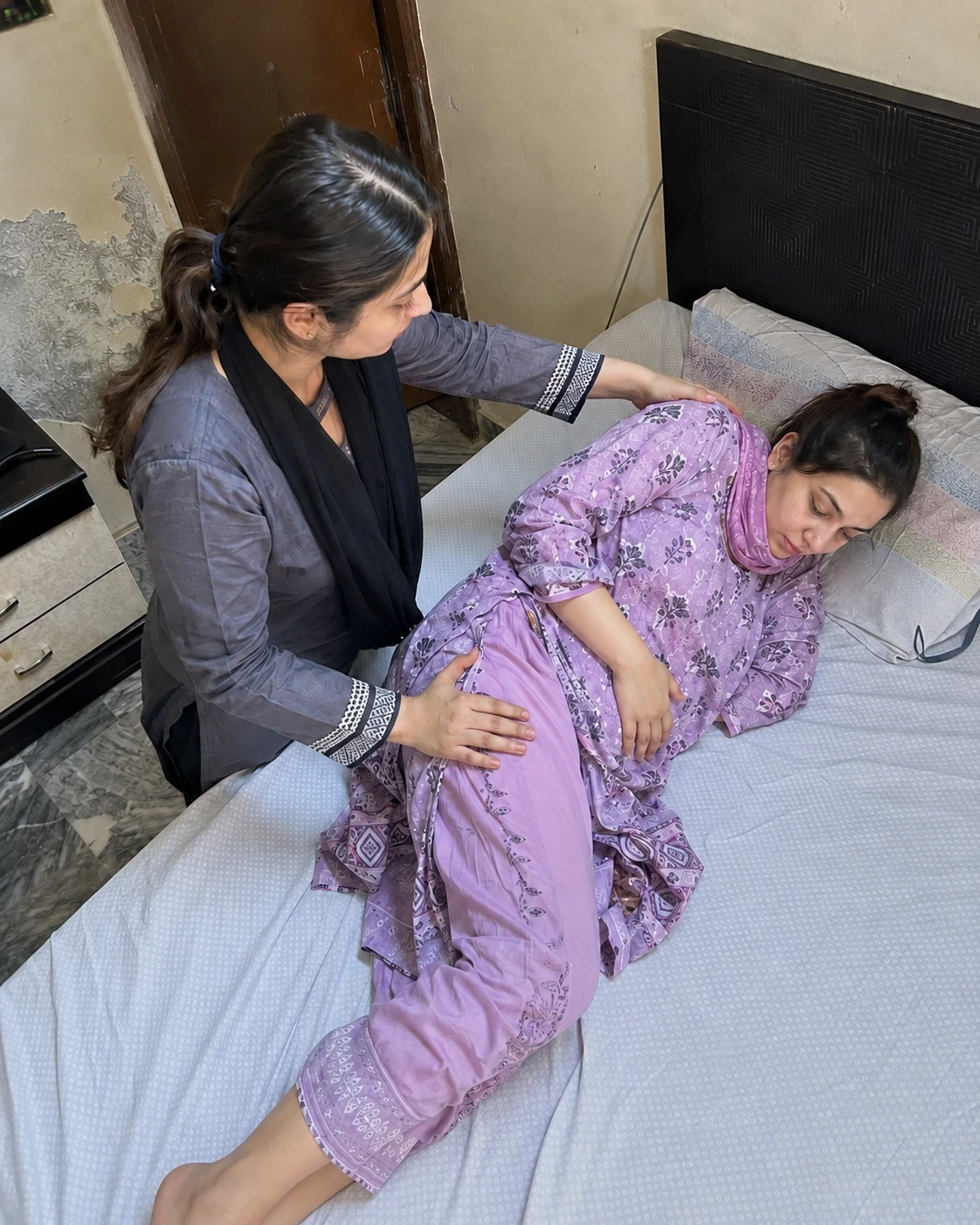
In the context of post-cesarean rehabilitation, core work begins with relearning how to breathe and how to manage intra-abdominal pressure. The transverse abdominis - the deepest abdominal muscle, wrapping like a corset around the torso - cannot be trained by sit-ups. It responds to breath-patterned, low-load activation. The pelvic floor, which forms the base of the core system and works in coordinated synergy with the transverse abdominis and the diaphragm, has been under sustained load throughout pregnancy and then abruptly destabilised by surgery. It needs to be gently reactivated, not aggressively contracted.
If you are six weeks postpartum and your OB has cleared you, the starting point is not a plank. It is lying on your back with knees bent, taking a gentle exhale, and feeling a very light lifting and drawing-in of the lower abdomen - without bracing, without holding your breath, without pain. That is one repetition. That is the foundation. Everything else - bridging, bird-dog, functional loading - comes later, progressively, with a therapist who can assess whether your diastasis recti has resolved sufficiently to tolerate load.
If someone is telling you to do crunches at two weeks postpartum, they are not giving you advice. They are gambling with your pelvic floor and your scar. Full stop.
Red flags that mean stop immediately and contact your OB or physiotherapist:
Visible doming or coning along the midline when you brace, lift, or exhale forcefully
Urinary leakage during any exercise, even gentle ones
Sharp pain at the incision site during any movement
A feeling of heaviness or pressure in the pelvis that worsens with exertion
Increased vaginal bleeding after any physical activity
C-Section Recovery in Karachi's Real World
Karachi is not a recovery-friendly city by default. Many women live in multi-floor buildings where the lift works intermittently. Extended family dynamics mean there is always someone who needs something, and rest is sometimes treated as a character flaw. Water shortages mean hauling buckets. Load-shedding means navigating dark stairwells. The pressure to bounce back - to be seen cooking, cleaning, and functioning normally within days of major abdominal surgery - is not theoretical. It is social, and it causes real clinical harm.
I have seen women develop scar adhesions so dense that the scar adheres to the underlying fascia because they resumed full household activity in week one and never did the scar mobilisation work that should begin around six weeks. I have seen women at three months postpartum with persistent muscle cramps and lower back pain that trace directly back to unresolved diastasis recti and a pelvic floor that was never rehabilitated - because nobody told them physiotherapy was relevant after a C-section.
Recovery is not about being strong enough to ignore pain. It is about progressively loading healing tissues in the correct order, at the right time. A physiotherapist who comes to your home - who sees your actual staircase, your actual bed height, the real distance from your bedroom to the kitchen - can adapt a rehabilitation plan to your environment in a way that a YouTube video never can.
Sehat Door At-Home Physiotherapy & Post-C-Section Rehab - Book Now A qualified female DPT comes to your home - no clinic, no commute. Book your session at sehatdoor.pk.
Post-C-Section Recovery Mistakes That Cause Real Damage
Forcing full household activity in weeks one or two - sweeping, mopping, climbing stairs with heavy loads - because "my mother did it and was fine." Individual variation in healing is enormous. Her experience tells you nothing definitive about the state of your fascia.
Doing crunches, leg raises, or intense ab work as soon as the scar looks healed from the outside, completely ignoring that the linea alba and anterior rectus sheath are still remodelling underneath.
Wearing a tight abdominal binder continuously, day and night, using compression as a substitute for actual core activation. A binder provides passive support. It does not teach the transverse abdominis or pelvic floor to function. Extended binder use without active rehabilitation can delay the reactivation of deep core motor patterns.
Ignoring persistent oozing, swelling, warmth, or escalating pain at the incision and attributing it to “normal recovery taking months.” A wound infection, scar dehiscence, or seroma is not something to observe and wait. Call your OB.
Letting family pressure override medical advice - being shamed for resting, or criticised for requesting physiotherapy. Postpartum rehabilitation is healthcare. Your request for it is not weakness.
Starting a generic online "postpartum workout" without any assessment of diastasis recti, scar tissue mobility, or pelvic floor function. The programme was not designed for your specific surgery, your specific healing, or your specific body.
Rapid-Fire Clinical FAQs
How soon after a C-section can I start walking?
Very gentle, assisted walking can typically begin within 24 hours of surgery under Enhanced Recovery After Cesarean protocols, once your surgical team is satisfied with your vitals and bleeding. Final clearance always comes from your OB or surgeon - not from this article or any online source.
When is it safe to start stretching after a C-section?
Upper-body stretches, ankle and calf mobility, and diaphragmatic breathing are generally safe to begin within the first one to two weeks if your OB has not restricted activity. Deeper trunk stretches involving spinal extension or rotation should wait until at least four to six weeks and be guided by a physiotherapist who can assess scar mobility first.
When can I start core exercises after a C-section?
Breath-based transverse abdominis and pelvic floor activation can begin once you are medically cleared - often after the six-week OB check for uncomplicated cesareans. Loaded abdominal work, including any form of crunch or sit-up, is generally delayed until at least eight to twelve weeks, and only after a formal assessment by a Karachi physiotherapist at home who can screen for diastasis recti and scar adhesion before progressing load.
How do I know if I'm overdoing it during C-section recovery?
Increased vaginal bleeding after activity, pain that does not settle with rest, new redness or swelling at the incision, fever, shortness of breath, or dizziness. If any of these appear, stop all activity immediately and contact your surgeon or go to the nearest emergency department. Do not wait.
Can I climb stairs after a C-section if I live in an apartment building?
Use the lift whenever it is functioning. If stairs are unavoidable, go slowly, use the bannister, and take one step at a time. Any increase in pain, bleeding, or wound discomfort after stair use means you need to reduce frequency and inform your OB. The staircase is not exercise equipment at this stage.
Is a pulling or burning feeling at my C-section scar normal when I move?
A mild, dull pulling when you first stand upright is common in weeks one through six - it is scar tissue under gentle tension. That is expected. What is not expected: sharp or escalating pain, a tearing sensation, discharge from the wound, warmth, redness, or pain that does not settle with rest. If you experience any of these, call your OB or go to urgent care. Do not treat it as routine.
Do I really need a physiotherapist, or can I follow YouTube workouts for C-section recovery?
YouTube workouts cannot assess whether your diastasis recti has closed sufficiently, whether your scar has adhered to the underlying fascia, or whether your pelvic floor is weak, hypertonic, or dyscoordinated - all of which change what exercises are safe for you. A qualified physiotherapist providing post-C-section rehab at home in Karachi gives you an individualised assessment and a programme that evolves as your healing progresses. That is not a luxury. It is the standard of care you deserve after major abdominal surgery.
Without a functioning core and a rehabilitated pelvic floor, the physical demands of new motherhood - carrying, feeding, bending, climbing stairs - are distributed onto structures that were never designed for that load. The consequences are not immediate. They build: persistent lower back pain, pelvic organ prolapse, urinary leakage that "just happens now," a scar that pulls and restricts movement years later. None of this is inevitable. All of it is addressable - but it requires treating recovery as a process, not a countdown to being told you are cleared.
Medical Disclaimer: This article is intended for general postpartum rehabilitation education only. It does not constitute medical advice and cannot substitute for clinical assessment and clearance from your obstetrician, surgeon, or physiotherapist. If you experience any red-flag symptoms - heavy bleeding, fever, wound oozing, severe pain, or shortness of breath - seek immediate medical attention.
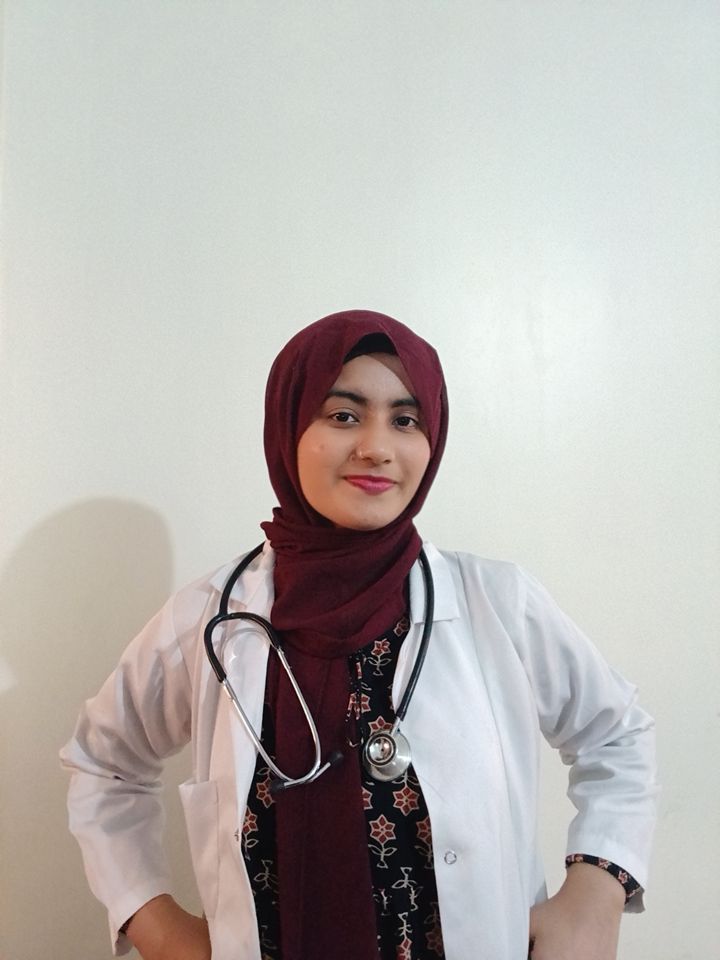
Dr. Aleena PT
A Physiotherapy Doctor (DPT) from Jinnah Sindh Medical University, focused on musculoskeletal rehabilitation, evidence-based patient care, pain management, mobility improvement, and recovery support.