Standing All Day Over the Karahi: Eid-ul-Azha Lower Back, Foot and Knee Pain Relief Plan
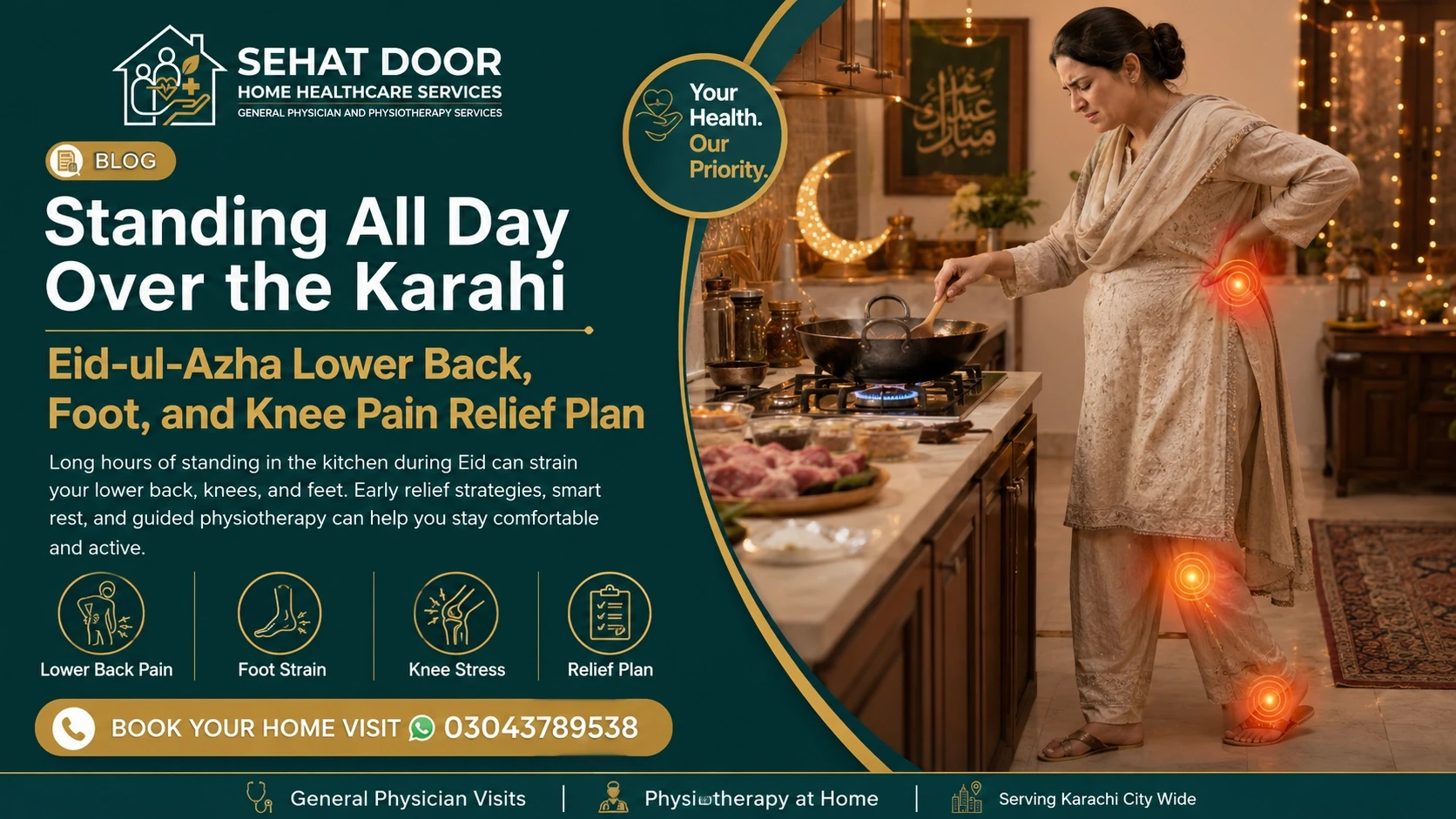
Eid-ul-Azha is anything but a silent holiday in Karachi. The kitchen is full of life at 6am - meat being washed, spices being ground and oil shimmering in the karahi before the majority of the city has had its chai. The next eight to ten hours is an ordeal for the women who work in those kitchens as they stand, bend, lift and stir over gas flames that raise the ambient temperature well above forty degrees. This is not the kind of cooking you do when you're in the kitchen for fun. The volumes are huge, the time is tight and there's virtually no sitting down. When the last guests are gone, your lower back may be aching from the weight of the day, your knees feeling the impact of hundreds of micro-steps on hard floor tiles, and your feet may feel like they don't belong to you.
What you feel is not weakness, and it is not simply 'being tired.' Standing for long periods in a fixed or slightly bent-forward position places constant compressive load on the lower back, decreases blood flow to the knee cartilage and causes blood to pool in the veins of the lower leg. A 2026 experimental analysis published in the journal Human Factors and Ergonomics in Manufacturing confirmed that standing work significantly increases low back pain scores over time, with lumbar muscle fatigue and postural strain as the dominant mechanisms. That was in controlled laboratory conditions - not a Karachi kitchen on Eid day, with steam, heat, heavy pots and no one to tell you to sit down.
This guide is based on clinical practice, not a textbook. As physiotherapists working in Karachi physiotherapy at home via SehatDoor, we see the same patients every year in the days after Eid: new lower back pain, worsened knee swelling, heel pain that appeared 'out of nowhere.' It is not out of nowhere. It builds across one cooking marathon and gets worse every year it is ignored. Here is what is actually happening to your body - and what you can do about it.
Quick Relief & Risk Reference
What You're Doing in the Kitchen | What It Does to Your Body | One Better Option |
Standing in front of the stove for 1–2 hours straight | Overloads lower back, knees and leg veins; muscles fatigue, blood pools, joints become stiff and sore | Set a timer every 20–30 minutes to step back, change position, or sit for 2–3 minutes before continuing |
Cooking on hard tiles in flat or thin-soled chappals | Increases impact and strain on feet, knees and lower back, raising the risk of pain and swelling | Wear cushioned, supportive footwear and stand on a folded or anti-fatigue mat in front of the stove |
Bending from the waist to reach lower shelves or heavy pots | Rounds the lower back and strains the discs and ligaments | Hinge from hips with a slight bend in knees, or bring items to counter height at the start |
Doing all the work yourself with no sharing of chores | Overworks the same joints and muscles for hours, especially the primary homemaker | Assign tasks (washing, chopping, serving) and rotate so no one stands in the same posture all day |
How Eid Cooking Hurts Your Back, Knees and Feet
Lower Back Pain from Leaning Over the Karahi
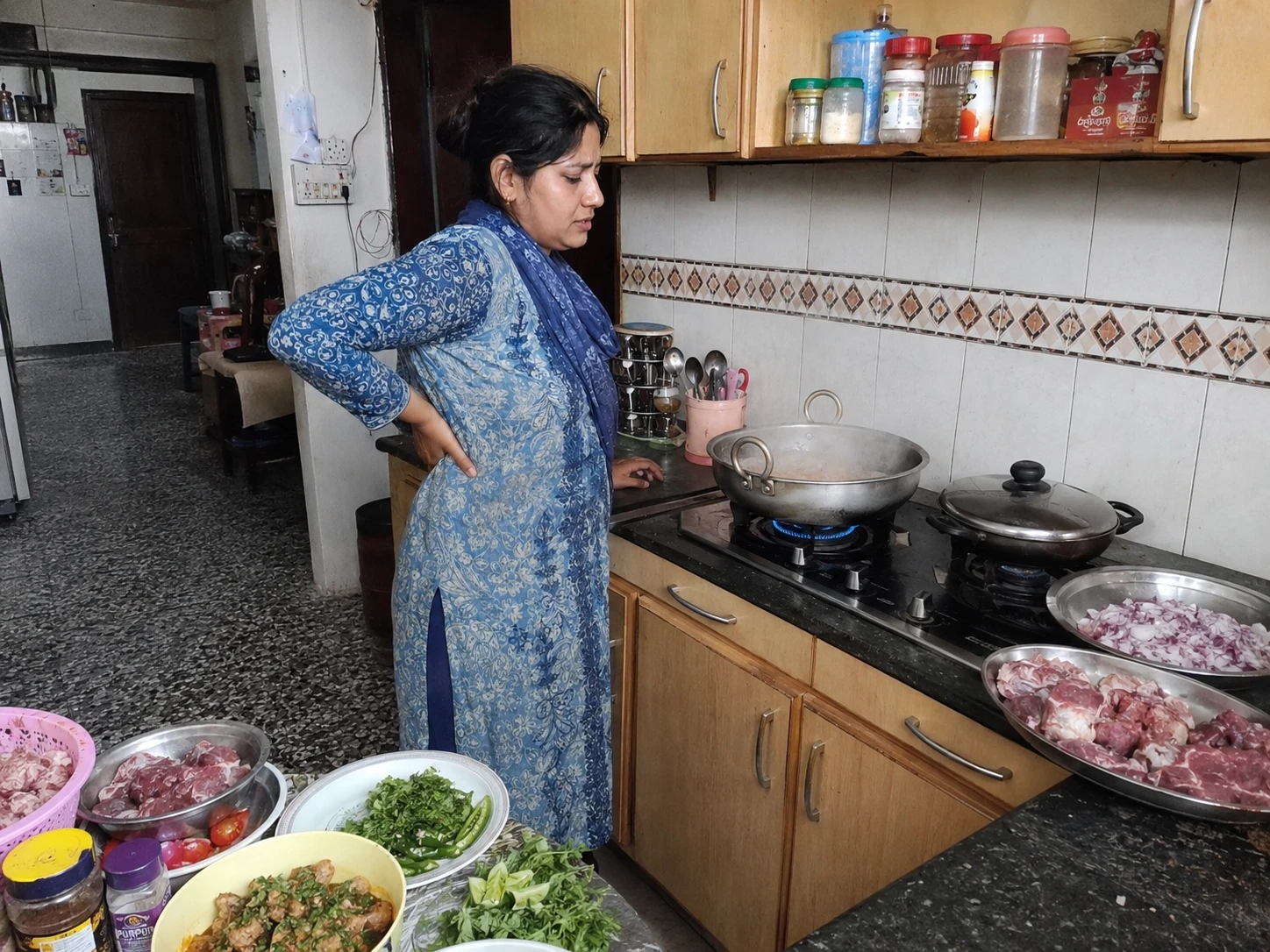
Watch any homemaker cooking a large qorma or nihari. She is not standing straight. She is slightly bent forward at the waist to reach across the wide karahi to stir without splashing, and to assess consistency. This forward lean is held for minutes at a time and repeated for hours on end - placing the lumbar spine in what physiotherapists refer to as sustained flexion load. The extensor muscles of the back (erector spinae and multifidus) are constantly working to prevent full collapse, but unlike a dynamic movement they never get to rest. Muscle fatigue sets in after about 30–40 minutes of continuous standing and leaning. The muscles no longer work efficiently and the load transfers to the passive structures: the intervertebral discs, posterior ligaments and facet joints.
The outcome is the dull, spreading ache in the lower back that most homemakers describe as 'my back giving out' by mid-afternoon. It is not structural failure - it is muscular and discal overload. Repeated over several years, this same mechanism is exactly how chronic low back pain develops. A 2026 Springer chapter on occupational low back pain consistently links prolonged standing - particularly in women - with the incidence of low back pain in occupational populations. A Karachi housewife working alone through Eid cooking is doing the equivalent of a full nursing shift, minus the ergonomic footwear, height-adjustable surfaces and mandatory breaks.
Adding heat from the stove makes this worse than it sounds. Warm and fatigued muscles lose tensile stiffness more quickly. When you lean over a hot karahi for two hours, your back muscles are contracting in a hot, dehydrating environment with no opportunity to reset. For those who already have a history of lumbar disc issues or lower back stiffness from daily household work, Eid cooking can be the single event that tips subclinical pain into something that takes weeks to settle.
Knees That Scream by Maghrib
Knees were not designed for static load. They were designed for movement - the contraction and release of the quadriceps and hamstrings drives synovial fluid through the cartilage, delivering oxygen and nutrients to tissue that has no direct blood supply. That pumping action ceases when you stand in the same spot for hours. Joint pressure stays elevated, synovial fluid stagnates and cartilage begins to operate under conditions it cannot sustain long-term. That is why your knees are not just aching by Maghrib - they throb, they're stiff and they may take a while to straighten once you finally sit down.
For women who already have patellofemoral stress - pain around or behind the kneecap - or any degree of early osteoarthritis, prolonged standing accelerates the discomfort significantly. The extra weight of heavy pots and trays compounds the issue: each kilogram carried adds roughly four kilograms of force through the knee joint when walking, and more when stepping down to reach low cabinets. See also: when knee deformities and physiotherapy intersect - the same joints are under stress whether the loading comes from gait deviation or hours of kitchen standing.
When you bend down to the lower shelf of the cabinet, the stabbing pain you feel is the patellofemoral joint being loaded at an angle it is too fatigued to manage. Do it ten times in one cooking session, on top of six hours of static standing, and you have created the conditions for acute knee inflammation that will not resolve with one night's sleep.
Feet That Feel Like Bricks: Plantar Fascia and Venous Pooling
That heavy, burning sensation in the soles of your feet after a full day in the kitchen has two separate causes working together. The first is mechanical: standing on hard ceramic tiles in flat chappals or thin-soled sandals forces the plantar fascia - the thick connective tissue band along the bottom of the foot - to absorb constant compressive and tensile load without the cushioning it needs. A 2025 foot pain analysis found that 32% of people with foot pain from prolonged standing also reported related discomfort in their knees, hips or back - the foot is not an isolated structure; its overload travels upward. When the plantar fascia is repeatedly stressed without recovery, it develops micro-tears and inflammation, leading to stabbing heel pain that is worst with the first steps of the morning.
The second cause is vascular. Blood returning from the feet must travel upward against gravity, pumped by the calf muscles contracting and releasing with each step. That calf pump is largely inactive when you are standing still. Blood pools in the small veins of the lower leg, venous pressure rises and fluid leaks into surrounding tissue. This is venous pooling - and it explains why your feet and ankles swell by evening, your legs feel 'stone-heavy,' and you may experience a dull ache and tightness in the calves that has nothing to do with muscle soreness. Research published in late 2025 confirms that prolonged standing is a significantly stronger risk factor for venous disorders than sitting, and that symptoms including aching, swelling, heaviness and fatigue can progress to chronic venous insufficiency if the pattern is repeated without intervention.
In Pakistan, varicose veins are not uncommon among women who do high-volume standing work. Estimates suggest a prevalence of 16–20% in the general population, with occupation being a major modifiable risk factor. Eid cooking is one of the most concentrated single-day standing exposures many homemakers experience all year. It is worth taking seriously.
Why "I'll Rest After Guests Leave" Backfires
There is a certain Eid stubbornness - admirable, honestly - the homemaker soldiering on with sore feet and an aching back because the guests are still there and the chai has to be made. The intention is generous. The physiological cost is real. By the time you finally sit down at 11pm, the inflammation in your joints and soft tissues has been building for twelve hours without the anti-inflammatory effect of movement, elevation or rest. You are not resting - you are stopping.
The difference matters. Micro-breaks during work - even two minutes of sitting, shifting weight, or marching in place - give the lumbar muscles a brief unload, help the knee joints redistribute synovial fluid, and activate the calf muscle pump to briefly reduce venous pressure. A 2-minute break every 25 minutes does not slow your cooking. It prevents the kind of inflammatory cascade that takes three to five days to resolve. Collapsing into a chair at midnight, by contrast, gives your body no opportunity to manage the damage in stages.
There is also a genuine sense of guilt many homemakers feel about sitting while guests are present. This is worth naming outright: if you stop for 2 minutes to stretch your calves or change your shoes, you are not neglecting your guests. Ending up with a herniated disc or a knee flare-up that keeps you in bed for the rest of Eid week is what actually disrupts the household. Rest is not the reward for finishing. It is part of the work. For more on how static postures - sitting or standing - drive musculoskeletal damage, see this breakdown of prolonged posture and body pain.
When Pain Means More Than Just Fatigue
Red-Flag Symptoms: Seek Medical Attention Urgently
Most Eid-related back, knee and foot pain is musculoskeletal fatigue and will improve with rest, ice or heat, gentle movement and - if needed - physiotherapy. But some symptoms are not fatigue. The following require urgent medical evaluation, not a home stretch routine:
Sudden, severe back pain more intense than anything you have had before, especially after a lifting or twisting motion.
Pain extending down one or both legs (sciatica), numbness, tingling or weakness in the foot - this may indicate disc compression on a nerve root.
Foot drop - difficulty lifting the front of your foot - is a neurological emergency.
Significant knee swelling, warmth and redness appearing rapidly, which may signal acute joint injury, infection, or crystal arthropathy (gout).
Calf pain with swelling, warmth and redness in one leg - this warrants same-day evaluation to rule out deep vein thrombosis (DVT).
Chest pain, shortness of breath or dizziness while standing or cooking - do not attribute these to fatigue; seek emergency care.
If in doubt: see a doctor first. Physiotherapy cannot and should not replace medical assessment for the symptoms above.
Your Eid Kitchen Body-Save Plan
These are not theoretical suggestions. They are the same instructions given to patients before Eid who have existing back, knee or foot problems and want to get through the day without a setback. They work for everyone.
Before cooking starts: Warm up for 5 minutes - ankle circles, gentle back extensions (stand straight, hands on lower back, gentle arch backward ×10) and marching in place for one minute. Cold muscles under immediate sustained load are more susceptible to injury. Two minutes of this is enough to change how your back and legs feel by hour three.
Set a 25-minute timer: Every 25–30 minutes, step away from the stove for 2–3 minutes. Sit. Walk a few steps. Do five slow calf raises. This is not a luxury - it is the single most effective thing you can do to prevent venous pooling and lumbar fatigue from compounding.
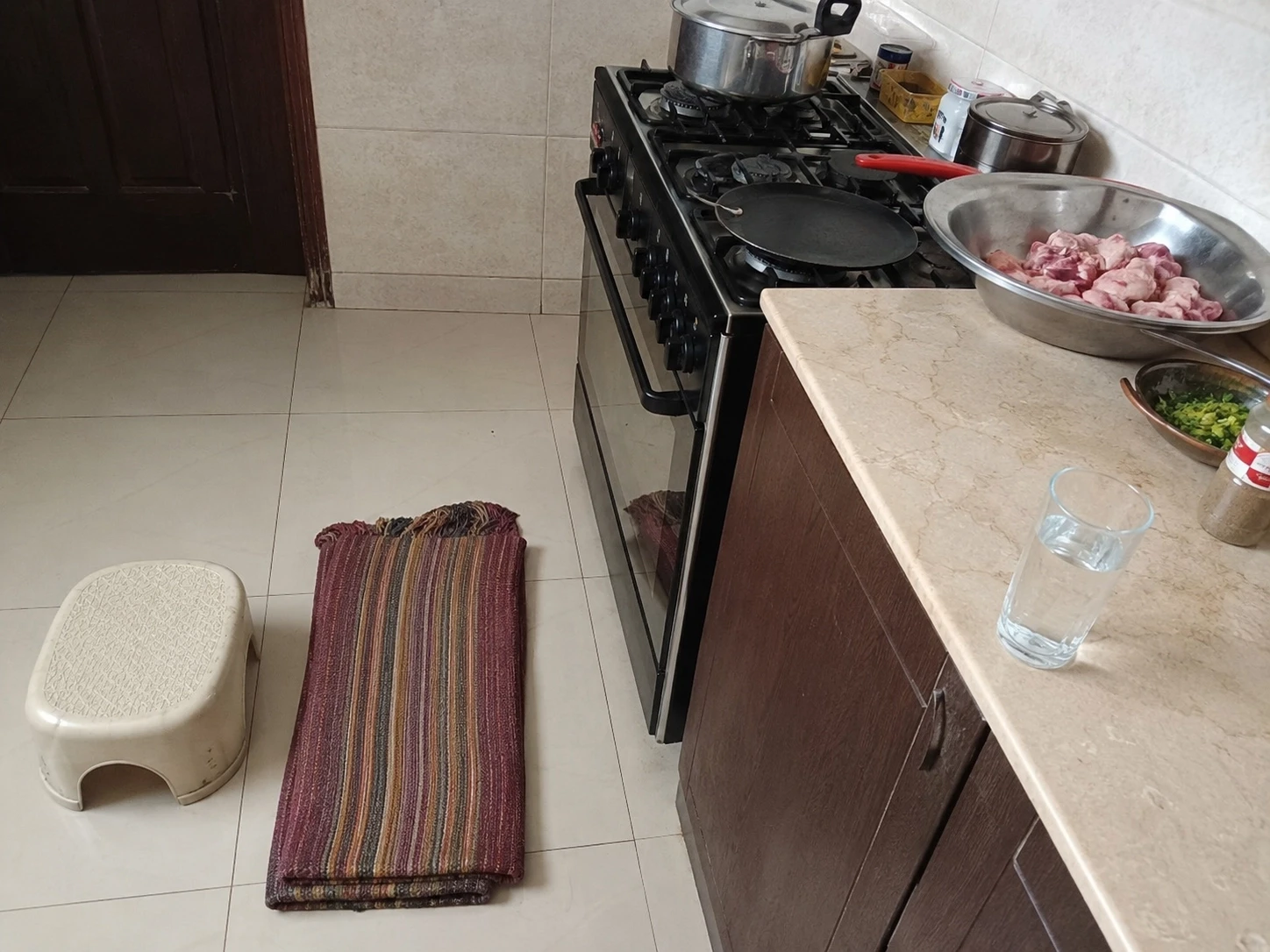
Alternate legs on a footrest: Place an empty crate, folded towel or low stool in front of the stove. Alternate resting one foot on it while standing. This shifts pelvic tilt, reduces lumbar load and breaks the static posture without requiring you to leave the stove.
Use two working heights: Heavy chopping and marination go on a higher surface (or the dining table) to prevent forward bending. Lighter tasks like stirring happen at the stove. The aim is to stop spending six hours in the same slightly-flexed lumbar position.
Change your footwear: Wear shoes or sandals with a cushioned sole and arch support - EVA or foam midsoles, not flat rubber soles. Do not cook in flat chappals or bare feet. Even a pair of cushioned trainers is vastly better than what most homemakers cook in.
Stand on a mat: A folded yoga mat, kitchen mat or even a folded bathmat in front of the stove reduces tile impact by 20–30%. It sounds trivial. Your plantar fascia and knees will notice the difference by hour four.
Distribute the work: One person serves. One person washes. One person manages chai and dessert. The primary cook does not do all of it. This is not shirking - it is the difference between recovering in one day versus one week.
After cooking - 10-minute cool-down: Back extension stretch (cobra position, gentle), seated calf stretch (towel around foot, pull toes toward you), and if possible, legs elevated for 15–20 minutes for venous return. This is not optional if you already have leg heaviness or varicose veins. Also see how extreme heat worsens muscle cramps and joint pain - relevant in Karachi's Eid-season heat.
Rapid-Fire Clinical FAQs
1. Is it normal for my lower back to hurt after standing all day cooking on Eid?
After a full day of cooking with prolonged lumbar load and no breaks, muscular lower back aching is extremely common and predictable. If the pain resolves with rest within 24–48 hours, it is likely muscle fatigue. If it does not improve, worsens or radiates down your leg, see a physiotherapist or doctor - that presentation needs assessment.
2. What kind of footwear is best if I'm standing for several hours in the kitchen?
Cushioned, closed-toe shoes with arch support are ideal - EVA or foam midsoles, not flat rubber soles. If you must wear sandals, choose a supportive sports sandal over a flat chappal. Bare feet on ceramic tiles for more than an hour will stress the plantar fascia and add knee load. If foot pain is recurring, a physiotherapist can assess whether you need a custom or semi-custom insole.
3. How often should I sit down or take breaks to protect my knees and back?
Every 20–30 minutes is the practical clinical recommendation for sustained standing. Even 2–3 minutes of sitting or walking resets muscular load and activates the calf pump. If that feels impossible during busy service, at minimum alternate one foot on a raised surface every 15 minutes.
4. Can standing all day cause long-term damage to my knees or veins?
Yes - repeatedly and without recovery. Occupational research consistently links years of sustained standing with higher rates of knee osteoarthritis and chronic venous insufficiency. One Eid will not destroy your knees, but the same pattern year after year - without addressing footwear, positioning and rest - can accelerate cartilage wear and worsen venous disease. A physiotherapist or vascular specialist can assess your risk if you have existing symptoms.
5. Which simple exercises can I do in the kitchen or living room to reduce pain after cooking?
Calf raises (10–15 reps), seated hamstring stretch (lean forward from hip), standing lumbar extension (hands on lower back, gentle backward arch ×10) and ankle circles are the most practical post-cooking exercises. If knee swelling is present, do not force flexion - see a physiotherapist for guidance appropriate to your specific condition.
6. When does back or leg pain from standing mean I should see a doctor urgently rather than just resting?
See a doctor urgently if you have: pain shooting down the leg with numbness or weakness; significant one-sided leg swelling, warmth and redness (possible DVT); sudden severe back pain following a lift or twist; inability to control bladder or bowel (a medical emergency); or chest pain and breathlessness. These presentations go beyond musculoskeletal fatigue and require medical - not physiotherapy - triage first.
7. Is physiotherapy really useful if my pain is "just from housework"?
Housework is physical labour, and 'just' does not belong in that sentence. At-home physiotherapy assessment identifies whether your pain is muscular, discal, joint-related or vascular in origin, and provides targeted treatment - manual therapy, exercise prescription, postural correction and ergonomic advice - that rest alone cannot deliver. If your Eid back pain is a returning problem, understanding physiotherapy vs. other treatments is worth doing before you decide what kind of help to seek.
The work you do on Eid-ul-Azha - the marinating and cutting and stirring and serving and washing and smiling through all of it - is real physical labour. It compresses the same lumbar discs that a construction worker stresses. It loads the same knee cartilage that a nurse's twelve-hour shift does. The difference is that construction workers have safety standards, nurses have shift limits and homemakers have none of those protections. Ignoring pain year after year is not resilience - it is how subclinical back and joint problems become chronic, disabling conditions. Your body does not forget the cumulative insult. It keeps a running account. The breaks you take today, the footwear you change, the task you delegate - these are investments against a pain debt that compounds faster than most people expect. Take them seriously.
Disclaimer: This article is written for general educational purposes only and does not constitute medical advice, diagnosis or a treatment plan. Always consult a qualified healthcare professional for assessment and management of any pain or medical condition.
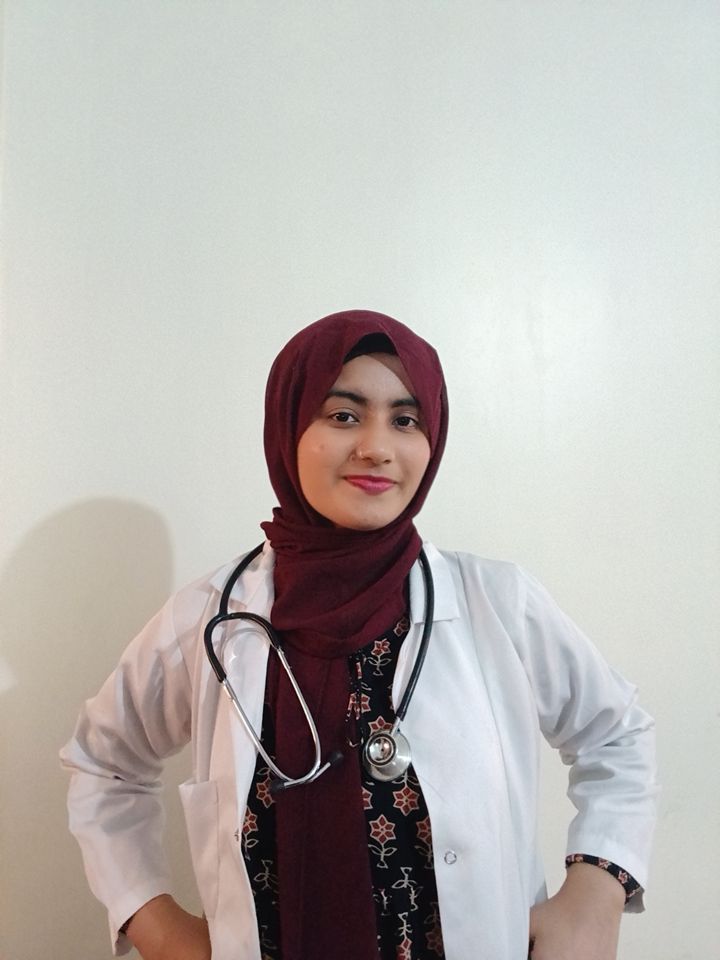
Dr. Aleena PT
A Physiotherapy Doctor (DPT) from Jinnah Sindh Medical University, focused on musculoskeletal rehabilitation, evidence-based patient care, pain management, mobility improvement, and recovery support.