
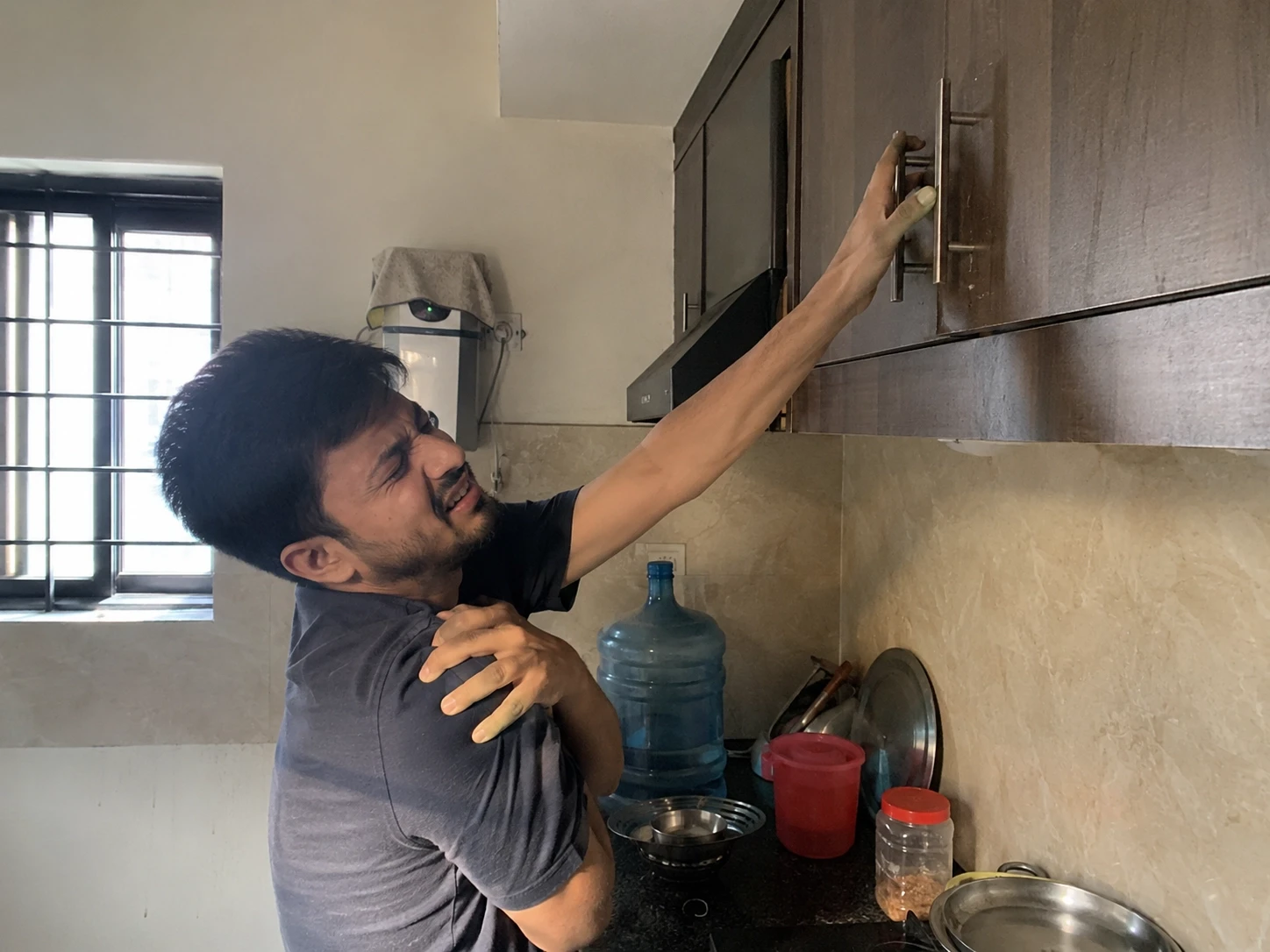
It usually starts without a dramatic injury. You reach for something on the top shelf and feel a sharp catch. You shrug it off. A few days later, wearing a shirt - specifically that moment when your arm crosses overhead - produces the same pinch. Then it's lifting a bag, combing your hair, sleeping on that side. Before you know it, you've spent weeks adapting every small movement around one shoulder, and nobody has given you a clear explanation of what's actually wrong or what to do about it.
The description you gave is typical for rotator cuff-related shoulder pain (RCRSP), also known as subacromial pain syndrome (SAPS), and previously referred to as 'shoulder impingement'. It is the most prevalent musculoskeletal disorder of the shoulder seen clinically. Published data from 2025 confirms that subacromial-region pain accounts for roughly 44–65% of all shoulder complaints seen in clinical settings. But, and most importantly, 54% of people with shoulder pain still report persistent symptoms at three years - many due to a combination of being told to rest, given a painkiller, and sent away without any structured rehabilitation programme.
The language has changed with modern clinical thinking, and it is good that it has. The old 'impingement' model - bone pinching tendon - is too simplistic to explain what is going on. The 2025 Clinical Practice Guideline published in JOSPT considers this condition to be a continuum of rotator cuff tendon capacity, scapular control, shoulder loading patterns and pain sensitivity - not just anatomy. That change is significant: it indicates that the initial treatment for the overwhelming majority of individuals with this presentation is not imaging, not injection, and certainly not surgery. It is a well-designed, progressive exercise programme. This article will help you understand what is going wrong with your shoulder, why resting it is not getting you the results you want, and what physiotherapy can realistically offer.
Is This My Shoulder? Quick Reference
What You Feel | What It Might Mean | What to Do Next |
Sharp pain on the outer/top of the shoulder when you lift your arm between about 60° and 120° | Classic "painful arc" often seen in rotator cuff-related shoulder pain / subacromial pain. | Avoid repeatedly provoking that arc for now, note which movements trigger it, and book a physio assessment. |
Pain when reaching overhead, behind your back, or lifting objects away from the body | Tendons and bursa in the subacromial space may be irritated by load and position. | Modify or break tasks into smaller loads and seek assessment if it lasts more than a few weeks. |
Night pain when lying on the shoulder, plus weakness raising the arm | Suggests more significant tendon involvement or weakness that needs structured rehab - possibly imaging if severe. | See a PT and/or doctor; don't rely on rest and painkillers alone. |
Sudden inability to lift the arm after a fall or heavy lift | Possible acute rotator cuff tear or serious injury. | Skip self-treatment. Get urgent medical evaluation - this goes beyond routine impingement. |
What Shoulder Impingement Really Is
From 'Pinched Tendon' to Rotator Cuff-Related Shoulder Pain
The term 'impingement' had, for decades, one single meaning: mechanical narrowing of the space between the upper arm bone (humerus) and the bony arch above (acromion), resulting in pinching of the tendon between the two. Clean, anatomical, straightforward. The problem is that the research never fully supported this model. Plenty of people with dramatically narrow subacromial spaces on imaging have no pain at all, and plenty with severe pain have structurally normal anatomy on scan.
The actual clinical picture is rotator cuff-related shoulder pain (subacromial pain syndrome): a condition where the tendons and bursa of the shoulder become sensitised and load-intolerant, driven by a combination of tendon overload or disuse, altered movement patterns (scapular dyskinesis - when the shoulder blade is unable to move normally), muscle weakness, and in some cases longstanding changes in how the nervous system processes pain. A 2025 systematic review and network meta-analysis explicitly states that the majority of cases previously referred to as 'impingement' should now be understood and addressed within the framework of RCRSP.
What does this mean to you? If it's not purely mechanical compression, then decompressing the space surgically is not the automatic answer. The same guideline that renamed the condition also confirmed - at the highest evidence grade - that subacromial decompression surgery is not recommended as routine treatment for rotator cuff tendinopathy. For the majority of people, the path forward runs through rotator cuff tendinopathy rehabilitation, not the operating theatre.
Daily Habits That Load Your Shoulder the Wrong Way
Consider your normal daily routine. People working at a laptop or desktop are likely to be spending hours with shoulders rounded forward and head in front of the body. This prolonged posture flattens out the upper back and causes the shoulder blade to point forward and outwards, decreasing the clearance in the subacromial space every time you raise your arm. Repeat this motion hundreds of times a day in that posture and the load placed on the rotator cuff tendons soon exceeds what they can comfortably absorb. The Sehat Door blog covers how eight-hour desk routines create injury patterns in Karachi office workers. The shoulder is one of the first structures that pays the price - and tech neck and forward-head posture are direct contributors, a problem covered in detail in the tech neck guide on the Sehat Door blog.
It's not only desk workers. Homemakers doing repeated overhead tasks - hanging laundry, reaching high shelves, scrubbing - can load the shoulder repetitively without realising it. The typical gym-goer with overhead or behind-the-neck pressing and poor scapular control is a staple presentation in any physio clinic. Manual workers carrying loads asymmetrically on one side. Even sleeping positions: if you consistently sleep with one arm raised above your head, you're compressing your own subacromial space for hours at a stretch.
None of these are catastrophic single events. This is why rotator cuff-related shoulder pain is insidious - it develops slowly, through accumulation. By the time the painful arc or the night ache appears, the tendon has often been under excessive, repetitive load for months. Identifying which specific activities are driving your particular pattern is one of the first things a physio assessment should address.
Why Rest Alone Does Not Fix It
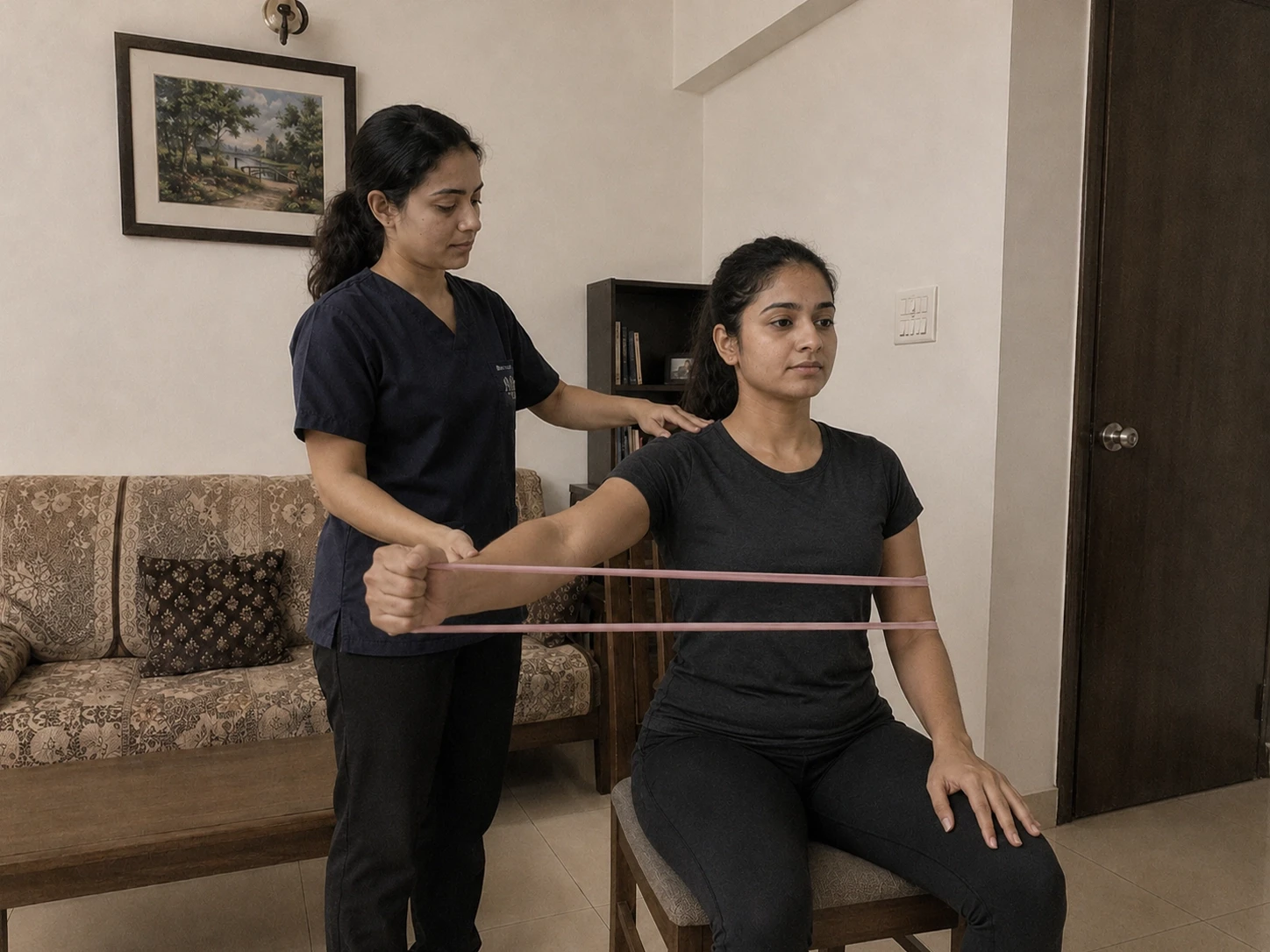
It's natural to rest an injured shoulder - if the movement causes the pinch, then don't move. And for the first few days after a flare, relative rest does help reduce irritability. The trouble is what happens next. A tendon that is rested completely starts to lose tensile capacity. The rotator cuff muscles weaken from disuse. The shoulder becomes, paradoxically, less tolerant of load than before - so when you return to normal activity, the pain comes back faster and at lower thresholds.
People get stuck in this cycle: pain, rest, some improvement, return to activity, pain again. It can last for years. Research confirms that graded, structured exercise is the cornerstone of RCRSP management. A 2025 systematic review and meta-analysis across multiple exercise modalities found consistent improvements in pain and function when exercise was applied progressively - specifically because it gradually rebuilds the tendon's tolerance and restores the rotator cuff's ability to generate the forces needed to stabilise the humeral head during movement.
The key phrase is graded and specific. Random YouTube exercises done sporadically are not the same thing. Exercises that worsen pain by loading the shoulder in the wrong direction or at the wrong intensity can set things back. This is precisely where a physiotherapist's ability to assess which movements you're missing, which muscles are underperforming, and which directions your shoulder tolerates is irreplaceable. You cannot skip strengthening and expect lasting change - that part of the evidence is unambiguous across every guideline and review published in 2025 and 2026.
What a Good Physiotherapy Plan Actually Looks Like
A well-structured rehab programme for rotator cuff-related shoulder pain is not a single exercise sheet handed to you at your first appointment. It evolves through stages. Here's what the evidence - the 2025 JOSPT Clinical Practice Guideline and a February 2026 JOSPT systematic review on shoulder strength rehabilitation - says a good plan should contain:
Education about load and pain. Understanding that some discomfort during exercise can be acceptable - and that it does not equal tissue damage - helps people stay in the programme long enough for it to work. Fear of movement is one of the main drivers of prolonged disability.
Progressive rotator cuff and scapular strengthening. Starting with low-load isometrics to settle irritability, then moving to isotonic strengthening - external rotation, shoulder elevation, scapular retraction - as tolerance builds. The progression must be structured, not random.
Mobility work where genuinely limited. Not every shoulder needs stretching - some are hypermobile and need stability, not more range. A physio assessment determines which applies to you.
Posture and movement coaching. Re-training the thoracic spine to extend, and the scapula to upwardly rotate properly during overhead reach, removes the mechanical loading patterns that contributed to the problem in the first place.
A paced return to your specific activities. Whether that's overhead sport, hanging laundry, carrying a laptop bag, or pressing in the gym - the rehab programme should be designed around what you actually need to do, not a generic template.
If you're in Karachi and travelling to a clinic on difficult days or across town is a barrier, Sehat Door's at-home physiotherapy service brings this structured assessment and programme delivery to your home. For context on how physiotherapy compares to other manual therapy options, the Sehat Door guide on physiotherapy vs chiropractic vs massage is worth reading before you decide.
When You Need Imaging, Injections, or a Surgical Opinion
This is where clarity matters. The short answer: most people with rotator cuff-related shoulder pain do not need an MRI at first presentation, and they do not need surgery as a first-line option.
The 2025 Clinical Practice Guideline is explicit: imaging should not be used initially. Diagnostic ultrasound may be appropriate after 12 weeks of failed conservative care. MRI is not routinely recommended. This is because imaging findings - including tears visible on scan - correlate poorly with pain levels and often resolve or stabilise without surgical intervention. A tendon that 'looks bad' on MRI may not be what's causing your pain.
Signs That Require Urgent Evaluation Beyond Physiotherapy
Traumatic onset - fall, heavy lift, direct contact - with sudden inability to raise the arm. This pattern requires imaging to rule out an acute full-thickness tear.
Significant, rapidly progressive weakness that is disproportionate to pain levels.
Red-flag features: night pain with systemic symptoms (fever, unexplained weight loss), neurological signs (radiating arm pain, tingling, weakness below the elbow), or a history of cancer. These are not impingement - they need a medical workup first.
Failure to make meaningful progress after 12 weeks of a well-executed physiotherapy programme. At that point, referral to a musculoskeletal specialist for injection or surgical assessment is appropriate - not before.
Corticosteroid injections may provide short-term pain relief and can be useful to create a window for rehabilitation to progress - but they are an adjunct to rehab, not a replacement for it. The shoulder problem that caused the pain does not disappear with an injection.
If you've had a similar journey with tendon overuse in another joint, the Sehat Door article on tennis elbow covers the same rehabilitation logic for lateral elbow tendinopathy - the underlying principles of graded loading apply across all tendon conditions.
Home-Friendly Physio Tips
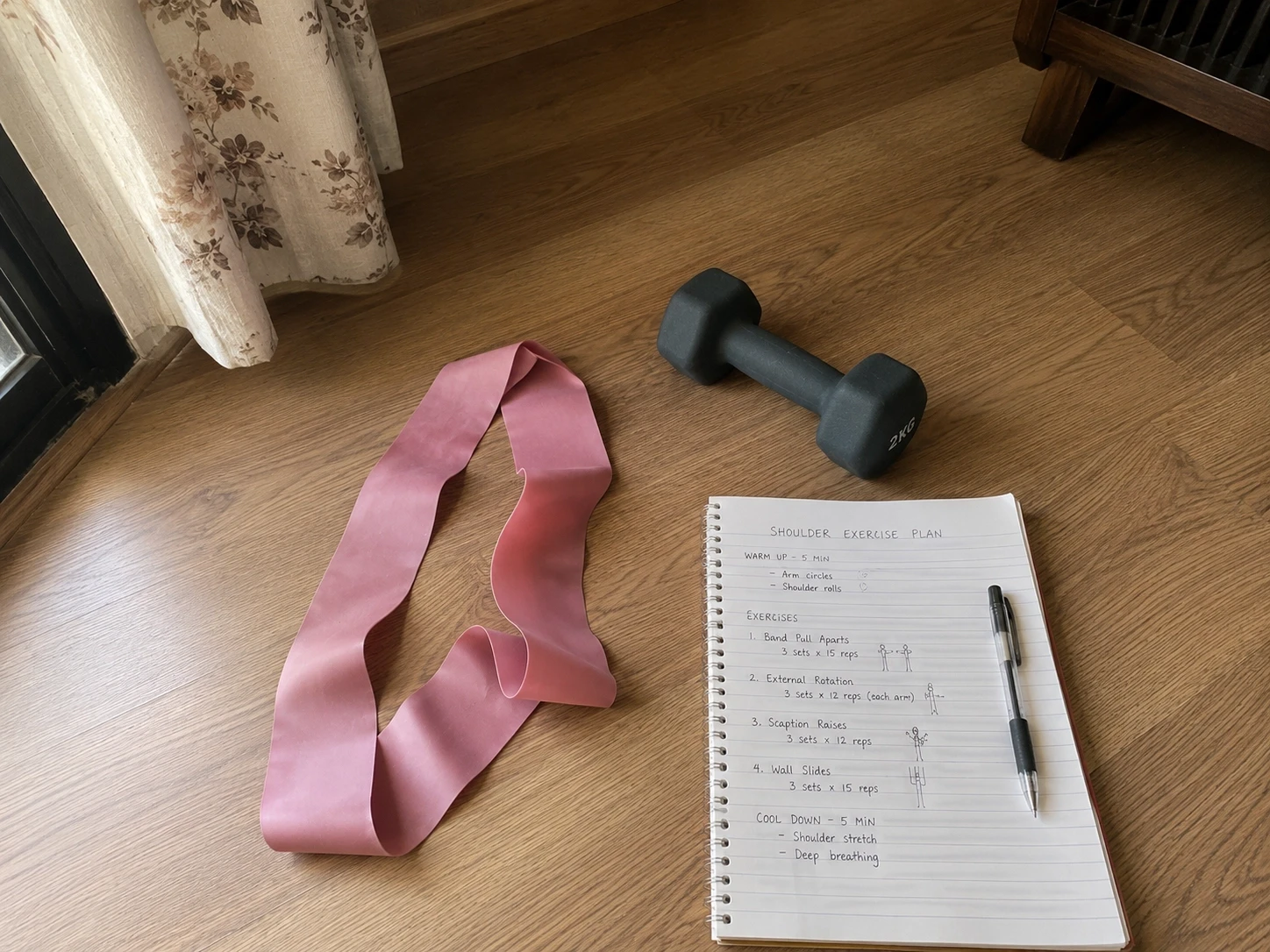
These are not a substitute for a professional programme - but they are the habits that determine whether rehab works or stalls.
Use pain as a guide, not an enemy. A pain score of 0–3 out of 10 during exercise is generally acceptable and does not indicate harm. Sharp, escalating pain above 5/10 during or after an exercise is your signal to stop or reduce load - not to quit altogether. The distinction matters.
Break overhead tasks into smaller steps. During a flare, move frequently used items to counter height. Use a step stool to reduce the arc your arm has to travel. This is not permanent - it is a temporary load management strategy.
Respect the 24-hour rule. If an exercise leaves your shoulder significantly more painful the following day than it started, reduce the load or repetitions - don't abandon the exercise. This response means you've exceeded capacity, not that the exercise is wrong for you.
Commit to one structured programme for at least 6–8 weeks before judging results. Tendons adapt slowly. Rotator cuff rehab rarely delivers dramatic improvement in two weeks. Switching programmes every fortnight based on YouTube recommendations is one of the most common reasons people plateau.
Sleep position adjustment. If lying on the affected shoulder is your trigger for night pain, place a pillow under the arm on the unaffected side to prevent you rolling onto the sore shoulder. Small adjustment, meaningful relief for many people.
Do not train into a flare. If your shoulder is acutely irritable - recent spike, heat over the joint, pain at rest - scale back to your lowest-load exercises or purely pain-free movement for a few days before resuming your full programme.
Rapid-Fire Clinical FAQs
How do I know if my shoulder pain is 'impingement' or something more serious like a tear?
Clinically, you cannot reliably distinguish these without a proper assessment. Clues that raise concern for a significant tear: sudden onset after trauma, dramatic weakness when lifting the arm from the side, inability to actively raise the arm above 90°. Any of these warrant medical evaluation and likely imaging - do not rely on a self-diagnosis from a symptom checklist. See a physiotherapist or doctor promptly.
Q: Can shoulder impingement go away on its own without physiotherapy?
Some mild cases do settle with activity modification and time, but published data indicates that 54% of shoulder pain cases still have symptoms at three years without structured intervention. Without addressing the underlying weakness and movement patterns, recurrence is common. A physiotherapy assessment is strongly recommended for any shoulder pain persisting beyond 4–6 weeks.
Q: How long does it usually take for shoulder impingement to improve with exercises?
The majority of people will notice meaningful improvement within 6–10 weeks of a consistent, progressive programme - though full resolution can take 3–6 months in longer-standing cases. The 2025 JOSPT Clinical Practice Guideline recommends reassessing at 12 weeks to determine whether additional interventions such as injections or specialist referral are needed if progress has stalled.
Q: Are rotator cuff exercises safe to do at home, or can I make things worse?
Low-load rotator cuff exercises - resistance band external rotation, isometric holds, scapular setting - are generally safe at home when introduced gradually. Poorly chosen exercises (especially aggressive stretching or heavy overhead pressing during an irritable phase) can provoke symptoms. This is why starting with a physiotherapist-designed programme, even via a single at-home assessment, gives you a safe foundation to follow independently.
Q: When should I get an MRI or ultrasound for shoulder pain?
The 2025 Clinical Practice Guideline advises against routine early imaging. Ultrasound becomes appropriate if symptoms fail to improve after 12 weeks of conservative care; MRI is reserved for cases with red-flag features, suspected full-thickness tear, or unexplained neurological signs. Ordering an MRI too early often produces findings - like partial tears - that look alarming but may not be the source of your pain, leading to unnecessary anxiety and over-treatment.
Q: Do I need surgery if my shoulder impingement hasn't improved in a few weeks?
No. A few weeks is far too early to consider surgery. Even major clinical guidelines confirm that subacromial decompression is not recommended as routine treatment for rotator cuff tendinopathy - even at 12 weeks if rehab has been insufficient. Surgery is considered only after a well-executed, adequately dosed physiotherapy programme has failed to produce acceptable improvement, or in specific structural situations such as large traumatic tears.
Q: Can I keep going to the gym if I have shoulder impingement?
In most cases, yes - with modification. Overhead pressing, behind-the-neck movements, and wide-grip pull-downs are commonly provocative and should be temporarily substituted. Neutral-grip rows, cable external rotations, and exercises below shoulder height are usually tolerable. A physiotherapist can help you audit your gym routine so you maintain fitness without repeatedly loading the irritated tissue - this is a much better approach than stopping the gym entirely.
Early Rehab Beats Living With It
Every week you spend adapting around an unrehabilitated shoulder is a week that weakness, altered movement patterns, and low-level tendon irritability become more entrenched. The shoulder does not reward patience without action. It rewards progressive, specific loading - the kind that gradually builds back what it has lost.
Whether you're a desk worker in Karachi whose shoulder began to ache after months of laptop hours, a homemaker whose overhead tasks became progressively harder, or a gym-goer who can no longer press without pain - the evidence points in the same direction. Get a proper assessment. Get a structured programme. Start it, stay in it, and progress it. Shoulder pain treatment at home in Karachi through SehatDoor means you can access certified physiotherapy assessment and programme delivery without the disruption of clinic travel on difficult days.
Years of 'living with it' is not inevitable. But it does become more likely the longer a proper rehab programme is delayed.
Medical Disclaimer: This article is intended for general educational purposes only and does not constitute diagnosis, treatment advice, or a substitute for professional physiotherapy or medical assessment. Individuals with persistent or worsening shoulder symptoms should seek in-person evaluation by a qualified physiotherapist or doctor. If you experience sudden severe weakness, inability to lift the arm, or red-flag symptoms, seek urgent medical care immediately.

Dr. Aleena PT
A Physiotherapy Doctor (DPT) from Jinnah Sindh Medical University, focused on musculoskeletal rehabilitation, evidence-based patient care, pain management, mobility improvement, and recovery support.